As inflation and food scarcity increase, Revolution Foods and Food Share of Ventura County are working diligently to bridge the nutritional gap within disadvantaged communities.
Food Share of Ventura County
This year, when Sylvia Cates encountered an unexpected car repair expense, she had to adjust her food budget accordingly. Since her husband’s retirement and her own decision to leave her bookkeeping position to care for her disabled brother-in-law, they have consistently juggled their finances—often leading to sacrifices in their grocery spending. While managing the costs of his uninsured medical supplies and cooking for both her husband and brother-in-law, who both have diabetes, Cates finds it challenging to meet their dietary needs amidst food insecurity.
“We were once middle-class and thought we could manage easily, but suddenly, our financial situation tightened significantly,” remarks Cates, 62, whose family’s monthly income is less than $3,000.
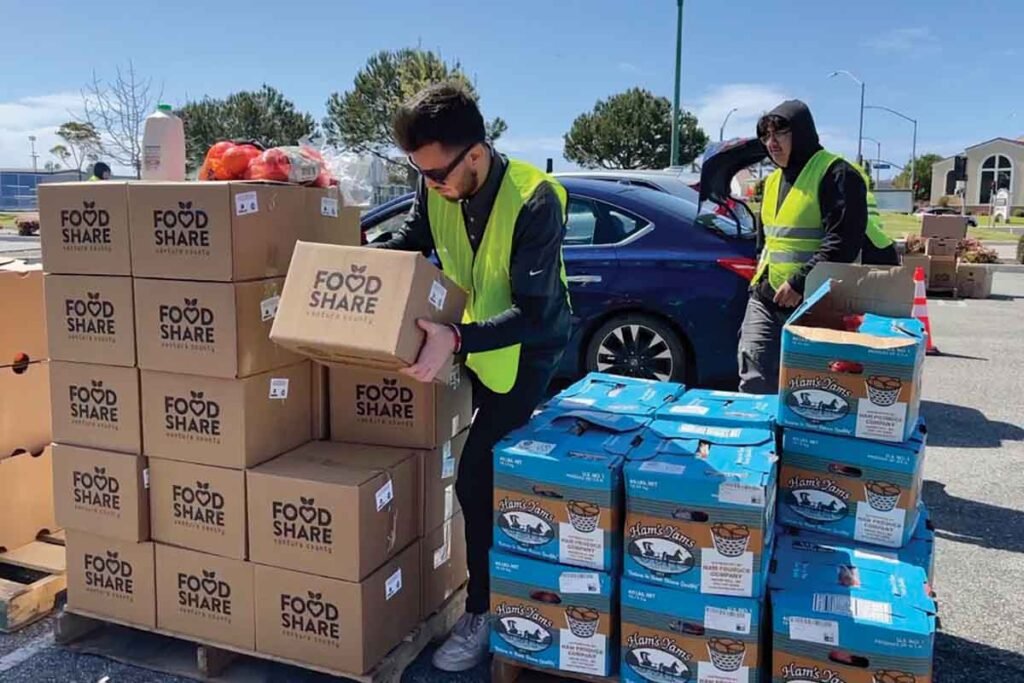
To help alleviate food expenses, Cates visits the Food Share of Ventura County warehouse each week for their drive-thru grocery distributions. She is one among 250,000 individuals that the nonprofit food bank—part of a vast network of 200 members with Feeding America—supports annually by distributing 20 million pounds of food.
Ensuring No One Goes Hungry
In Ventura County, one in four individuals faces food scarcity, and nearly 70% of homes must choose between paying for utilities or medical care and purchasing groceries.
“Hunger doesn’t have a single appearance,” emphasizes Food Share CEO Monica White. “We assist working families, veterans, and those without housing.”
Food Share’s mission dates back to 1978 when eight friends began cooking meals for local unhoused individuals. What began in a garage has now expanded into three warehouses that store non-perishable items from the USDA, surplus goods from grocery stores and farms, along with bulk purchases from manufacturers. After sorting, the food is distributed through drive-thru services or delivered directly to shelters, senior centers, food pantries, and schools in partnership with 180 nonprofit organizations.
Despite their contributions, a secure food future is still in jeopardy. Ongoing federal funding cuts worry White, who encourages community members to reach out to their representatives to advocate for these vital programs.
“We are a safety net, and we all must contribute to ensure it is strong enough to catch those who may fall,” she asserts.
In light of increasing inflation, Food Share aims to enhance its operations. It plans to move into a larger, newly constructed facility within the next three years, aiming to assist individuals like Cates more effectively.
“There’s absolutely no judgment here, and just having access to another resource brings immense relief,” she expresses.
Revolution Foods

Reflecting on his childhood, Jesus Rios recalls opening the fridge to find only a loaf of bread and a gallon of powdered milk—the moment he came to understand his family’s struggle with food insecurity. Now, as the principal of a public high school in East San Jose, he sees this reality mirrored in many of his students.
“After the pandemic, we’ve observed many students living in multi-family households and an increasing number of students without stable housing,” he observes regarding the learners at Latino College Preparatory Academy (LCPA).
To combat the hunger challenges that many students encounter before beginning their academic day, LCPA, alongside two other schools on the same campus, benefits from federal funding to partner with Revolution Foods. Supported by government initiatives, the California-based organization provides breakfast and lunch at no cost to the schools’ 650 students.
A Focus on Health and Nutrition
Revolution Foods extends its reach beyond California, also catering to students and seniors in neighboring Nevada, offering around 50 million meals annually. Recipients can select from over 70 culturally diverse meal options, all designed by nutritionists and crafted without trans fats, additives, or processed ingredients—ensuring that students stay energized.
“Sometimes, our meal may be the only food someone eats in a day,” states Revolution Foods spokesperson Heather Clevenger. “For students to succeed, they need proper nutrition.”
The Impacts of Hunger
A study conducted in 2023 assessed the educational outcomes related to food insecurity among early adolescents, revealing that limited access to food correlates with declining academic performance over time. This connection is something Rios staunchly supports within his school environment.
“Per Maslow’s hierarchy of needs, students must first have their basic physiological needs, like access to nutritious meals, met before they can engage in more complex cognitive tasks,” he explains.
Recent findings from the School Nutrition Association indicate that the Trump administration proposed to cut over $1 billion in funding to food assistance and school nutrition programs, with further reductions on the horizon. Clevenger encourages advocates to reach out to their local congress representatives to address these issues.
“Students and seniors often endure in silence, so it’s vital to keep highlighting the challenges they face,” she asserts.
At LCPA, Rios has seen first-hand the benefits of adequate nutrition.
“Our students are more energized, engaged, and prepared to learn with consistent meals provided twice daily, five days a week,” he states.
This article was originally published in the July/August 2025 issue of Thewindowsclubs magazine (US edition).