Amid rising inflation and increasing hunger, Revolution Foods and Food Share of Ventura County are working to bridge the nutritional gap by providing food to underprivileged communities.
Food Share of Ventura County
Sylvia Cates and her husband found themselves needing to adjust their spending after an unforeseen car maintenance expense hit earlier this year, causing them to dip into their grocery budget. This has become a common scenario since Cates’ husband retired and she stopped working as a bookkeeper to take care of her disabled brother-in-law. With the burden of providing for his medical supplies and preparing meals for him and her diabetic husband, Cates faces the challenge of ensuring adequate nutrition while also dealing with food insecurity.
“We used to be middle-class and had things under control, but suddenly, our situation tightened,” explains Cates, who now manages on less than $3,000 a month.
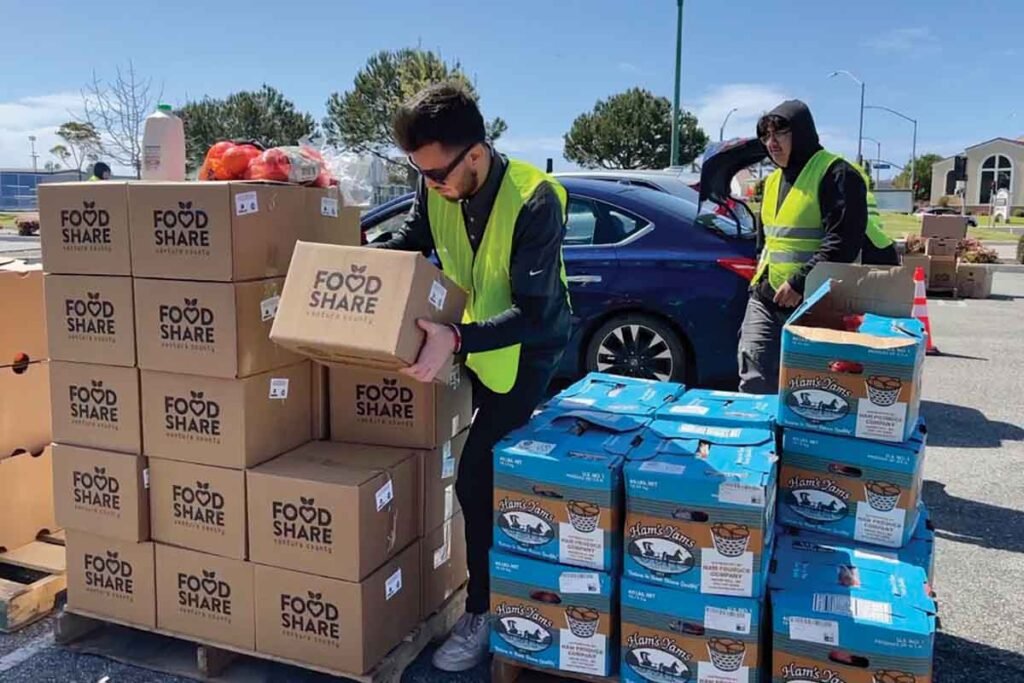
To alleviate her food expenses, Cates visits the Food Share of Ventura County warehouse each week for drive-thru grocery distributions. She is one among 250,000 individuals the nonprofit food bank—part of the Feeding America network—supports each year with over 20 million pounds of food distributed.
Ensuring No One Goes Hungry
In Ventura County, one in four residents faces food scarcity, with nearly 70 percent of households forced to choose between paying for utilities or medical expenses and buying groceries.
“There isn’t a singular profile for hunger,” observes Food Share CEO Monica White. “Our clients include working families, veterans, and those without homes.”
Food Share’s origins date back to 1978, beginning with eight friends who cooked meals for a local unhoused community. What started in a garage has transitioned into three warehouses, stocked with shelf-stable goods donated by the U.S. Department of Agriculture, surplus products from supermarkets and farms, and bulk acquisitions from manufacturers. After careful sorting, these items are distributed directly via drive-thru locations or allocated to shelters, seniors, food pantries, and schools through collaboration with 180 nonprofit partners.
Despite its substantial contributions, the future of food security remains precarious. White urges locals to engage with their representatives to advocate for sustained funding for such crucial programs.
“We serve as a vital support system, and it’s essential that everyone contributes to its strength so that those in need can recover,” she emphasizes.
As inflation continues to climb, Food Share is planning to broaden its operations. Within the next three years, they aim to transition to a larger, newly constructed facility to better assist individuals like Cates.
“There’s a lack of judgment in using their services, and simply knowing another option is available provides immense comfort,” she notes.
Revolution Foods

Jesus Rios recalls his childhood when he opened the fridge to find only a loaf of bread and a gallon of powdered milk, a moment that marked his family’s struggle with food insecurity. Now, as the principal of a public high school in East San Jose, he sees this reality reflected in many of his students.
“Post-pandemic, numerous students are living in overcrowded households and we have a noticeable increase in unhoused students,” he observes about the young people at Latino College Preparatory Academy (LCPA).
To combat the hunger issue many students face before their school day begins, LCPA and two other schools on the same campus use federal funding to partner with Revolution Foods. Through this collaboration, the California-based social enterprise provides free breakfast and lunch to the 650 students enrolled.
A Nutritional Focused Social Enterprise
Revolution Foods’ influence reaches far beyond California’s borders, serving students and seniors in neighboring Nevada and producing 50 million meals annually. Clients can select from over 70 meals reflecting various cultures, all designed by nutritionists to be free of trans fats, additives, or highly processed ingredients, aimed at ensuring students remain energized.
“For some, our meal might be their sole source of food for the day,” states Revolution Foods spokesperson Heather Clevenger. “It’s essential that children receive adequate nutrition to succeed in life.”
The Impact of Hunger
A 2023 study examining the relationship between food insecurity and academic performance among early adolescents revealed that lack of food access can lead to decreased academic achievements over time. This has been a significant part of Rios’ advocacy efforts in his school.
“According to Maslow’s hierarchy of needs, students must have their basic needs—including access to nutritious meals—met before they can engage in higher cognitive activities,” he explains.
Recent findings from the School Nutrition Association indicated that the Trump administration has proposed cutting more than $1 billion in funding aimed at food banks and nutrition programs in schools, with further reductions anticipated. To help counteract this, Clevenger encourages community members to reach out to their local representatives for support.
“Students and seniors are two demographics that often suffer quietly, so we must continue to highlight the difficulties they face,” she stresses.
At LCPA, Rios can observe the beneficial effects of proper nutrition directly.
“With consistent access to meals twice daily, five days a week, our students are now more spirited, involved, and prepared to learn,” he affirms.
This piece was initially published in the July/August 2025 edition of Thewindowsclubs magazine (U.S. edition).