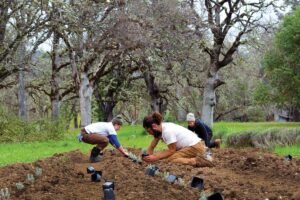
Elijah Goerzen’s farming practices evoke a simpler era. Operating Deep Roots Farm in Maple Ridge, BC, his eight-acre property, situated near Vancouver, prioritizes hand cultivation over machinery. This method fosters fertile, nutrient-dense soil that supports the growth of vegetables and the flourishing of beneficial organisms such as earthworms.
Goerzen’s approach to farming is free from toxic pesticides and chemical fertilizers; he opts instead to enhance biodiversity. For instance, he plants flowers amid his kale plants to invite ladybugs that help manage aphid populations and attract pollinators essential for fruit cultivation.
Innovative Farming Practices
The regenerative agricultural techniques that Goerzen employs to yield crops each season—as well as microgreens grown weekly in a sunroom—are considered by many as the future face of farming.
“My aim is to collaborate with nature as much as I can. I have had considerable success by avoiding pesticides, refraining from tilling, and cultivating as organically as possible while enhancing my soil,” Goerzen explains. “This approach differs from conventional practices, yet it’s been beneficial for me.”
His methods are also environmentally friendly. Distinct from traditional agriculture, regenerative farming seeks to tap into natural processes for food production rather than relying solely on synthetic additives.
Regenerative agriculture is vital for achieving 12 of the 17 UN Sustainable Development Goals and is recognized by the UN Environment Programme as a leading method to enhance food system sustainability and create a safer, cleaner, and more inclusive post-COVID world.
While he practices agroecology by avoiding pesticides and tilling, Goerzen also acknowledges the potential for modern food production techniques that could help expand his operations and feed the growing local community, all while adhering to his commitment to sustainably produce high-quality food in a limited space.
He expresses excitement about the opportunities container farming, aquaponics, and vertical farming might bring to Deep Roots Farm.
“I would be foolish not to consider it because, historically, there was a belief that vast acreage was necessary for significant food production, which is no longer the case,” Goerzen states.
Rising to New Heights
Vision Greens, a vertical farm located in Welland, Ontario, exemplifies this shifting paradigm. Situated near Niagara’s diminishing tender fruit region, this facility focuses on vertical farming to address the projected 60 percent increase in food demand by 2050.
The farm disrupts the imported lettuce market by implementing controlled environmental agriculture that emphasizes continuous, sustainable food production.
At Vision Greens, their industrial park headquarters features hydroponic towers teeming with organic seeds cultivated through a computer-controlled system that optimizes LED lighting, organic nutrients, water purity, airflow, and CO2 levels tailored to plant needs. The outcome: nutrient-dense lettuce harvested every 26 days, regardless of the season.
These crops are cultivated in an insect- and disease-free environment, and fluctuating weather conditions don’t affect them, which eliminates the necessity for pesticide use, explains Karen Gold, Vision Greens’ marketing lead. The farm also relies on clean energy from the city.
Products, supplied to major grocery stores like Metro and Food Basics in the Greater Toronto Area, are often delivered the same day they are harvested, covering only 76 kilometers. In contrast, typical conventional and organic romaine, primarily imported from California’s Salinas Valley, must travel over 4,300 kilometers, exposing it to various risks including bacterial contamination.
The very nature of their sustainable production and distribution means that Vision Greens’ lettuce will never need to be recalled for safety reasons, according to Gold. Additionally, with plans to establish one-acre vertical farms across Canada that boast 60 times the growing density and 135 times the crop yield of field-grown lettuce, the company stands ready to significantly contribute to developing secure local food systems alongside Deep Roots Farm.
“If you observe what’s unfolding in California—wildfires, flooding, and other climatic challenges—it’s clear that we can generate more food in less space and provide a steady supply year-round without interruptions,” Gold remarks.
Collaboration for a Sustainable Future
Goerzen is excited about the potential future of agriculture and sees a pivotal role for Deep Roots in tomorrow’s food systems.
“With innovations like vertical farming, container farming, and aquaponics, there are extensive possibilities from a technological standpoint to significantly boost food production,” he states.
Rather than positioning himself in opposition to larger corporate farms like Vision Greens, Goerzen believes that there is value in learning from all types of agricultural practices.
“The future of farming will entail local enterprises collaborating to foster thriving ecosystems within their communities. The more unity we cultivate, the more progress we will achieve,” he contends.
In Canada, agriculture contributes around 8 to 10 percent of greenhouse gas emissions, which exacerbate climate change. Effectively managed methods, whether through regenerative practices or advanced technologies like machine learning that minimize emissions, can increase resilience against climate change and preserve biodiversity.
Transitioning from open fields to vertical farming may seem like a futuristic concept. However, it actually draws from a long-standing pursuit for space-efficient agricultural practices.
Since its inception, NASA has explored methods for cultivating food in closed systems, aiming for self-sufficiency for astronauts venturing into lunar or Martian explorations.
The technology used today by companies like Vision Greens has its roots in NASA’s research and is further developed by the Norway-based Intravision Group. Both the agency and Intravision are conducting experimental studies at the University of Guelph’s Controlled Environment Systems Research Facility, about an hour’s drive west of Toronto.
After a successful pilot in 2017, Vision Greens launched its first full-scale system in 2020, utilizing Intravision’s technology that originated from NASA’s work.
This article originally appeared in the June 2024 issue of Thewindowsclubs magazine.