Those acquainted with oysters know that the northern shorelines of the United States are celebrated for their exquisite shellfish varieties. Enthusiasts rave about Beausoleils and Wellfleets from the East Coast, while Kumamotos and Hama Hamas have fans on the West Coast.
However, when it comes to oysters from the Southeast, many turn up their noses, pursing lips and shaking heads. Inferior oysters from warmer waters? Not on my platter of crushed ice. I admit—this used to be my perspective.
My outlook transformed when I encountered Shark Bite oysters from New Smyrna Beach in Florida. At an Oyster South symposium in St. Augustine, I was introduced to a dedicated group of entrepreneurs who are striving to improve the image of Southern oysters, provide benefits to their communities, and promote environmental sustainability.
Thanks to generous invitations, I spent a few days working on oyster farms. Equipped with rubber boots and coated in sunblock, I set out for the shores of the Atlantic and the Gulf.
Day one: On the Gulf
On a striking early morning, Reed Smith of Calusa Oyster Company greets me in South Tampa Bay. His associate, Reid Ballard, navigates us to their leasehold as Smith shares that he and his wife, Maura, have ventured into oyster farming without prior experience, casually stating, “Hey, we could do that!”
“Seafood is a family favorite, so it felt like a natural choice,” says Smith, gesturing towards the sparkling waters and often blue skies. “Besides, the view from the office is unbeatable.”
Most oyster cultivation in the Southeast takes place off-bottom in estuarine waters, where tides ensure a steady flow of nutrients. Floating cages filled with mesh bags containing oysters at varying growth stages bob in the water ahead of us.
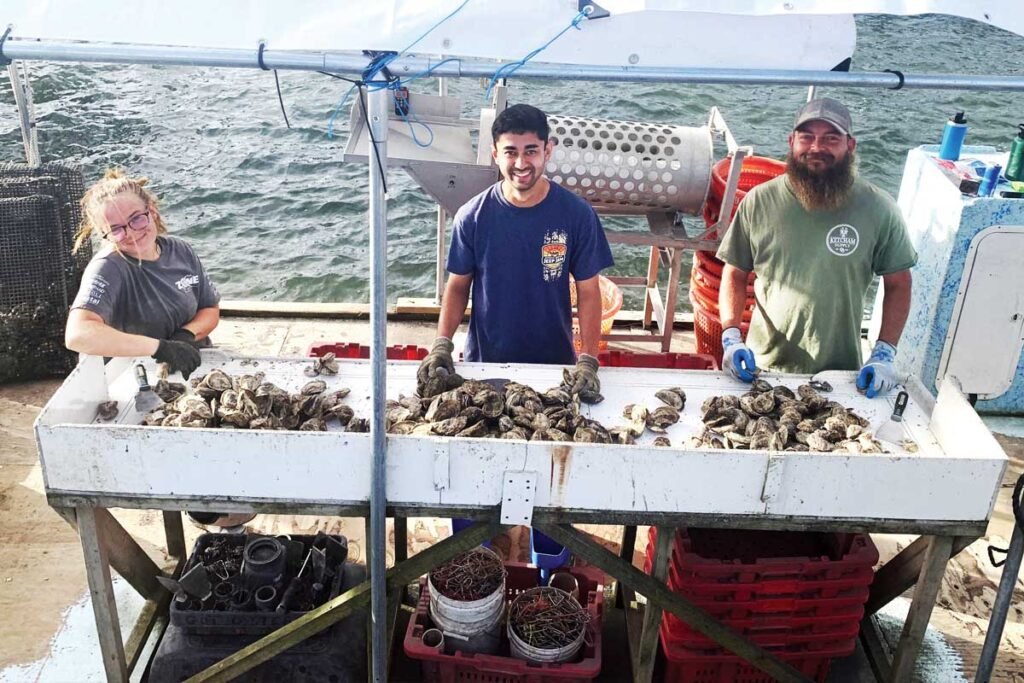
The main objective today is harvesting. Pulling up a cage and extracting a flattened bag proves to be quite labor-intensive. The cage structures are teeming with marine life; seaweed, crabs, and small fish abound. As Smith points out, “Our farm has evolved into a floating reef.”
To separate the oysters, the bags are tumbled through a rotating perforated cylinder that sorts smaller ones from those ready for harvest. The smaller oysters are destined for the local restoration initiative, Oyster River Ecology, which aims to support the wild populations critical to the ecological health of these waters. Smith emphasizes the distinction: “cultivation” is intended for eating, while “restoration” benefits the environment.
The somewhat monotonous process of cleaning and sorting facilitates discussion about personal insights into this lifestyle. Ballard shares: “Cultivating an organism that captures carbon, cleanses water, and nurtures habitat has made me realize the significant efforts needed to maintain a healthy environment.”
In Smith’s words, “Finding a business that positively impacts so many lives is incredibly fulfilling. Do you ever see people not grinning when they’re enjoying oysters?”
Day two: On the Atlantic
My visit to the Indian River Lagoon starts with a warm welcome from Nicolette Mariano of Treasure Coast Shellfish. As our small boat glides over the crystal-clear waters, Nicolette shares her long-standing interest in aquaculture, sparked during her teenage years spent volunteering at the Florida Oceanographic Coastal Center. Her Bachelor of Science degree reinforces her passion for her chosen career. “Being on the boat in the early morning, surrounded by the sights and sounds… from ospreys to dolphins to manatees surfacing for air, is exhilarating.”
At the dock, her crew gears up, diligently separating and sorting the oysters; any compromised specimens are tossed into the shallow waters, attracting swarms of different fish species. Mariano emphasizes the community benefits generated by the farm. “The oysters form an exceptional vertical habitat for younger organisms; the farm has genuinely become its own ecosystem. Additionally, we’ve created various job opportunities within our community for individuals of all ages.”
Challenges Faced
Dealing with mortality events and complex regulations is challenging, but the most significant hurdle is adverse weather. Hurricanes can devastate farms; for instance, Smith at Calusa lost an entire year’s harvest to Hurricane Helene. “It requires determination, hard work, creativity, resilience, and the ability to adapt. We keep pushing through and find solutions,” he states.
Support from the Florida Shellfish Aquaculture Association helps them navigate these challenges. Executive Director Adrianne Johnson emphasizes their mission: “Shellfish farmers exemplify hard work, resilience, and innovation. We strive to uplift this remarkable burgeoning industry in the South and encourage participation. Savor a southern oyster, support local farmers, and experience the difference.”
Despite the numerous obstacles, Ballard from Calusa expresses the sentiment shared by his fellow farmers: “There’s nothing I would trade this job for, not for any amount of money.”
This article first appeared in the November/December 2025 edition of The Windows Clubs magazine (US version).