If you’re at all familiar with oysters, it’s clear that the northern shores of the United States are famous for their exquisite shellfish. Enthusiasts rave about the Beausoleils and Wellfleets of the East Coast, while Kumamotos and Hama Hama oysters from the West Coast also enjoy a devoted following.
However, whenever the topic of Southeastern oysters arises, the response is often less than enthusiastic, with many expressing disdain for what they perceive as subpar oysters from warmer waters. I have to admit that I was among the skeptics.
Everything changed when I encountered Shark Bite oysters from New Smyrna Beach, Florida, which opened my eyes (and taste buds) to a different side of oyster culture. During an Oyster South symposium in St. Augustine, I was introduced to a group of enthusiastic entrepreneurs dedicated to improving the reputation of Southern oysters, enhancing community value, and positively impacting the local ecosystem.
They kindly invited me to spend a couple of days on their farms. Equipped with rubber boots and ample sunscreen, I set off towards the waters of the Atlantic and the Gulf.
Day One: Gulf Adventures
The day begins beautifully as Reed Smith from Calusa Oyster Company greets me in South Tampa Bay. His young partner, Reid Ballard, takes us out to their lease area, while Smith shares with a chuckle that he and his wife Maura serendipitously ventured into oyster farming with a casual thought: “Why not?”
“Our family loves seafood, making this a natural pursuit,” Smith explains, gesturing toward the sparkling waters and bright skies. “And honestly, the workplace is unbeatable.”
Oyster farming in the Southeast predominantly takes place in estuaries, where tides continuously mix vital nutrients into the water. We glide past floating cages filled with mesh bags containing oysters at different growth phases.
Today’s focus is harvesting. Retrieving a cage and extracting a flattened bag turns out to be quite labor-intensive. Sea life thrives around the cage structures, with crabs, seaweed, and small fish everywhere. As Smith points out, “Our farm has transformed into a floating reef.”
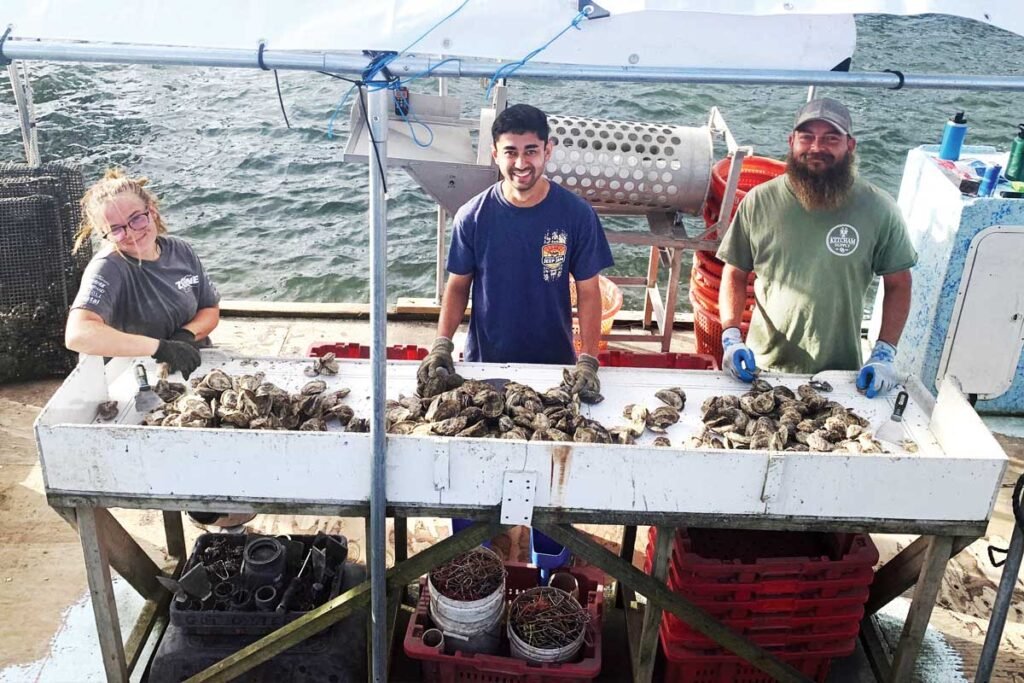
Inside the bags, oysters are sorted through a rotating perforated cylinder that separates smaller ones from those ready for harvest. Some of these smaller oysters will be donated to Oyster River Ecology, a local restoration initiative beneficial to wild populations crucial for the health of the waters. Smith differentiates between the two efforts: “cultivation” targets consumption, while “restoration” aims to support the environment.
The somewhat laborious task of sorting and scraping opens up conversations about the personal journeys in this profession. Ballard expresses his enthusiasm: “Raising an animal that captures carbon, cleans water, and fosters habitat growth has shown me the significant work still required to maintain our environment.”
Smith sums up the experience beautifully: “Finding meaning in a business that brings joy to people’s lives is a true gift. Who hasn’t seen someone smile while eating oysters?”
Day Two: Atlantic Insights
A dock on the Indian River Lagoon marks my welcome by Nicolette Mariano from Treasure Coast Shellfish. As we glide over the crystal-clear waters, she shares her lifelong fascination with aquaculture, which began when she volunteered at the Florida Oceanographic Coastal Center as a teenager. Her Bachelor of Science degree further solidified her enthusiasm for the field. “I adore the early morning boat rides, absorbing all the sounds and scents… the cawing of ospreys, the appearance of dolphins, and the manatees surfacing for air.”
At the dock, her crew dons slickers and begins sorting through oysters; any damaged specimens are tossed into the shallow water, where schools of fish swarm to consume them. Mariano remarks on the farm’s local impact, stating, “The oysters create incredible three-dimensional habitats for young organisms; our farm is truly a self-sustaining ecosystem. Additionally, we’ve generated various job opportunities for local residents, spanning different age groups.”
Overcoming Hurdles
Dealing with mortality events and an intricate web of regulations can be challenging, but the weather is often the biggest hurdle. Hurricanes can devastate farms; Smith from Calusa recalls losing a year’s worth of work due to Hurricane Helene. “It requires persistence, innovation, and adaptability. We find a way to overcome challenges and continue our work.”
The Florida Shellfish Aquaculture Association offers community backing, with Executive Director Adrianne Johnson emphasizing their goal: “Shellfish farmers are remarkable individuals, characterized by resilience and creativity. We aim to elevate this burgeoning industry in the South and encourage people to partake in its growth. Try a Southern oyster, support local farmers, and experience the difference.”
Despite the numerous obstacles, Ballard from Calusa articulates a sentiment shared by many farmers: “I wouldn’t trade this job for anything.”
This article was first published in the November/December 2025 edition of Thewindowsclubs magazine (US edition).