Those familiar with oysters likely know that the northern shores of the United States are famous for their exquisite shellfish. Lovers of oysters rave about the Beausoleil and Wellfleet varieties from the East, while Kumamoto and Hama Hama oysters from the West garner equally passionate applause.
However, when it comes to discussing oysters from the Southeast, many react with skepticism—turning up their noses and shaking their heads at the thought of inferior oysters from warmer waters. I’ll admit it: I was among those doubters.
That all changed when I had the fortunate experience of tasting Shark Bite oysters from New Smyrna Beach, Florida, which opened my eyes to a different realm of flavor. At an Oyster South symposium in St. Augustine, I met a dedicated group of entrepreneurs committed to revitalizing the reputation of southern oysters. Their mission is to enhance community value and contribute positively to the environment.
Extending a warm invitation, they welcomed me for a hands-on experience on their farms. With rubber boots packed and sunscreen applied, I eagerly set out toward the Atlantic and Gulf waters.
First day: On the Gulf
On a stunningly clear morning, Reed Smith from Calusa Oyster Company greets me in South Tampa Bay. His colleague, Reid Ballard, guides our boat toward their lease area. Smith shares that he and his wife, Maura, unexpectedly found their way into oyster farming, playfully stating, “Hey, we could do this!”
“Our family enjoys seafood, so it made sense to explore this path,” Smith explains, gesturing toward the beautiful waters and endless blue sky. “Plus, it’s hard to argue with this office view.”
Most of the Southeast’s oyster farming occurs in estuaries, with “off-bottom” techniques that benefit from nutrient-rich tidal waters. Ahead of us, floating cages bob gently, each filled with mesh bags containing oysters at different growth stages.
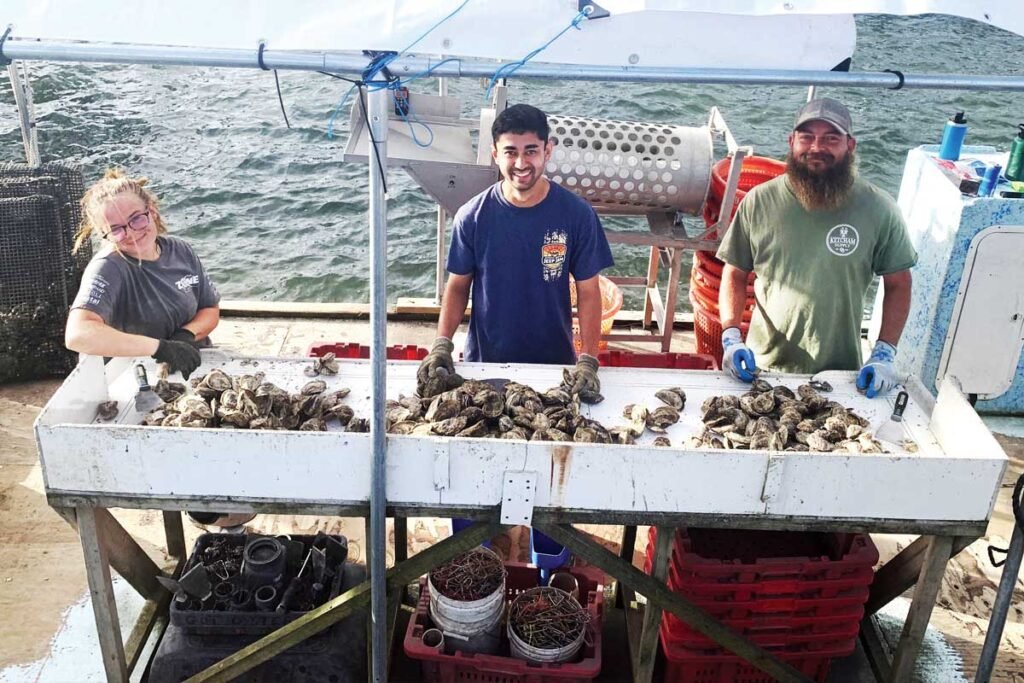
Today’s focus is harvesting. Pulling up a cage and retrieving a flattened bag proves to be quite a workout. Numerous sea creatures, including seaweed, crabs, and tiny fish, cling to the cage’s structure. “Our farm has transformed into a floating reef,” Smith observes.
The bags’ contents are sifted through a rotating perforated cylinder that sorts out smaller oysters from those ready for harvesting. Some of the smaller oysters will go to a local restoration effort, Oyster River Ecology, an initiative aimed at nurturing wild populations critical for water health. Smith elaborates: “Cultivation serves for consumption, while restoration aids the environment.”
This somewhat laborious task of cleaning and sorting opens the floor for sharing personal experiences in this field. Ballard shares what drives his passion: “Cultivating an animal that captures carbon, cleans the water, and fosters habitat growth has made me acutely aware of the work required to maintain a clean environment.”
Smith encapsulates it beautifully: “Finding a business that contributes positivity to people’s experiences is such a joy. When do you see a photo of someone not smiling while eating oysters?”
Second day: On the Atlantic
On the Indian River Lagoon, I am welcomed by Nicolette Mariano of Treasure Coast Shellfish. As our skiff navigates the sparkling waters, she shares her long-standing fascination with aquaculture, which began when she volunteered at the Florida Oceanographic Coastal Center at the age of 14. With a Bachelor of Science degree, her educational background greatly enhances her enjoyment of the profession she loves. “I cherish the early mornings on the boat, soaking in the sounds and scents of nature—the ospreys, dolphins, and manatees surfacing for air,” she remarks.
Once back at the dock, her crew dons slickers to begin sorting and separating the oysters. Any damaged ones are tossed into shallow waters where various fish eagerly gather to feed. Mariano emphasizes the local advantages stemming from their farming efforts: “The oysters provide an incredible vertical habitat for juvenile organisms, making the farm its own little ecosystem. Additionally, we have generated several jobs in our community for all ages.”
Challenges faced
While dealing with mortality events and navigating complex regulations can be challenging, the weather remains the biggest hurdle. Hurricanes can devastate farms; for instance, Smith at Calusa lost an entire year’s work to Hurricane Helene. “It requires dedication, creativity, resilience, and adaptability. We continually find ways to navigate challenges and keep pushing ahead.”
The Florida Shellfish Aquaculture Association offers vital community support. Executive Director Adrianne Johnson remarks on their mission: “Shellfish farmers are some of the most hardworking, resilient, and innovative individuals I know. We aim to elevate this emerging southern industry and welcome everyone to join in. Taste a southern oyster, support a local farmer, and you will see the benefits.”
Despite the obstacles, Ballard from Calusa emphasizes, “I wouldn’t trade this career for anything.”
This piece was originally featured in the November/December 2025 issue of Thewindowsclubs magazine (U.S. edition).