If you are somewhat familiar with oysters, you are likely aware that the northern shores of the United States are celebrated for their exquisite shellfish. Enthusiasts of these delicacies rave about Beausoleils and Wellfleets from the East Coast, while on the West Coast, Kumamotos and Hama Hamas take center stage.
However, bring up the oysters from the Southeast, and the reaction is often less than favorable, with many considering them inferior due to their warmer waters. I must admit, I used to share this skepticism.
But a chance tasting of Shark Bite oysters from New Smyrna Beach in Florida transformed my perspective. At an Oyster South symposium held in St. Augustine, I encountered a dedicated group of entrepreneurs passionately devoted to enhancing the reputation of Southern oysters, providing economic benefits to their localities, and improving the surrounding environment.
I received warm invitations to spend a few days working on the oyster farms. With my boots ready and sunscreen applied, I set off to explore the waters of both the Atlantic and the Gulf.
Day one: On the Gulf
On a stunning morning, I am greeted by Reed Smith of Calusa Oyster Company in South Tampa Bay. His colleague, Reid Ballard, steers our vessel towards their farm, as Smith shares that he and his wife Maura ended up in oyster farming quite unexpectedly—simply thinking, “Why not?”
“Seafood is a family favorite, so it seemed a natural path,” Smith explains while gesturing at the beautiful surroundings. “And the view from the office is unbeatable.”
In the Southeast, the majority of oyster farming takes place offshore in estuaries, facilitated by tides that refresh the water’s nutrients. Ahead, we see floating cages, each containing mesh bags with oysters at different growth stages.
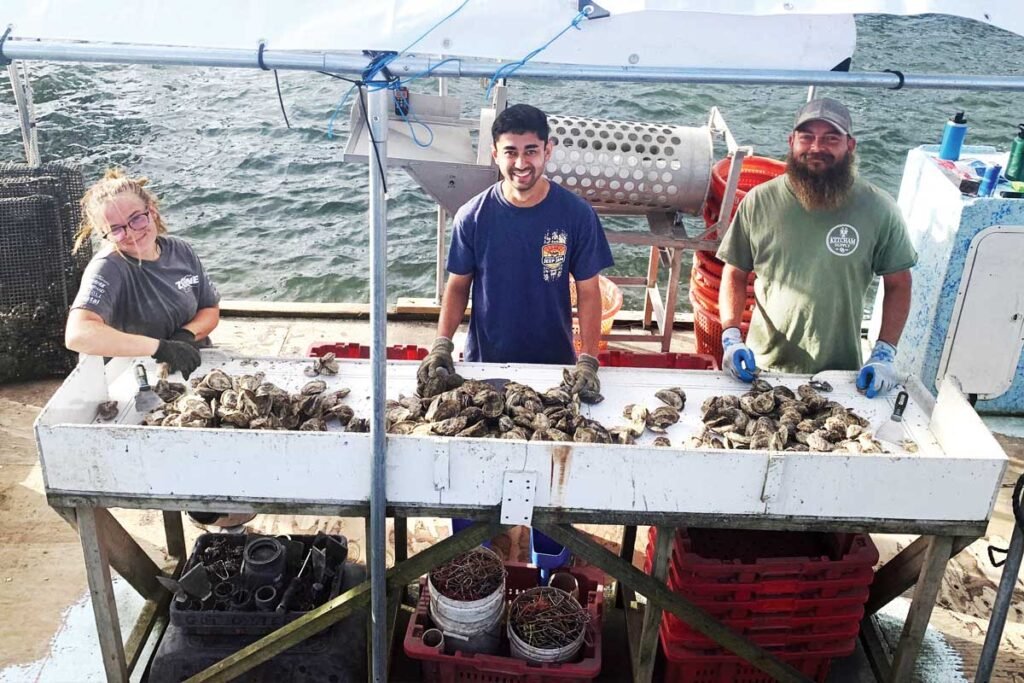
Our main task for the day is harvesting. Pulling up a cage and extracting a packed bag proves to be quite the workout. The cages are alive with marine life, including seaweed, crabs, and small fish. As Smith points out, “Our farm is evolving into a floating reef.”
The oysters are sorted through a rotating cylinder that separates the smaller specimens, funneling those ready for harvest. Some of these tiny oysters will be given to the local conservation initiative, Oyster River Ecology, to help sustain wild populations crucial for local ecosystem health. Smith clarifies the distinction: “cultivation” is intended for consumption, while “restoration” is for ecological balance.
This somewhat labor-intensive process allows time for reflective conversation. Ballard shares what motivates him: “Farming an organism that sequesters carbon, cleans water, and fosters habitat growth has opened my eyes to the importance of maintaining a clean environment.”
Smith echoes this sentiment: “It’s fulfilling to work in a field that brings joy to so many. Have you ever noticed anyone not smiling when they eat oysters?”
Day two: On the Atlantic
I arrive at a dock on the Indian River Lagoon, greeted by Nicolette Mariano from Treasure Coast Shellfish. As we glide over the pristine waters, she shares her lifelong passion for aquaculture that began when she volunteered at the Florida Oceanographic Coastal Center at the age of 14. With a Bachelor of Science degree, she combines a personal interest with professional expertise. “There’s something magical about being out on the water in the early mornings, surrounded by the sounds of ospreys, dolphins, and manatees surfacing for air,” she remarks.
Once back at the dock, her crew prepares to sort and categorize the oysters; damaged ones are returned to the shallow waters, attracting schools of fish that feed. Mariano discusses the positive impacts the farm has on the local ecosystem. “The oysters provide a unique vertical habitat for young sea life; this place is like its own ecosystem. We’ve also created various job opportunities within the community for individuals across different age groups.”
The challenges
While dealing with mortality events and complex regulations is no small feat, weather remains the biggest adversary. Hurricanes can devastate the farms; for instance, Smith at Calusa saw an entire year’s labor wiped out by Hurricane Helene. “This work requires endurance, creativity, adaptability, and tenacity. We find ways to navigate the challenges and keep pushing forward,” he shares.
Local backing is provided by the Florida Shellfish Aquaculture Association, whose Executive Director Adrianne Johnson emphasizes their mission: “Shellfish farmers are some of the most dedicated, resilient, and innovative individuals you’ll find. We aim to elevate this exciting, growing industry in the South and encourage others to join us. Try a southern oyster, support local growers, and experience the difference.”
Despite numerous challenges, Ballard from Calusa speaks for his fellow farmers when he states, “I wouldn’t swap this job for a million dollars.”
This piece was first published in the November/December 2025 edition of Thewindowsclubs magazine (U.S. version).