For anyone familiar with oysters, it’s no secret that the northern U.S. coastlines are famous for their exquisite shellfish. Enthusiasts rave about East Coast Beausoleils and Wellfleets, while West Coast aficionados highlight Kumamotos and Hama Hamas.
However, when the discussion shifts to oysters from the Southeast, there tends to be skepticism—often with raised eyebrows and pursed lips. Who would want subpar oysters from warmer waters? I admit, I was once among the skeptics.
That all changed when I had a chance encounter with Shark Bite oysters from New Smyrna Beach, Florida, during an Oyster South symposium in St. Augustine. There, I met a dedicated group of entrepreneurs whose goal is to revitalize the reputation of Southern oysters, generate economic opportunities for their communities, and improve local ecosystems.
With warm hospitality, they invited me to spend a couple of days on their farms. With my rubber boots packed and sunscreen applied, I eagerly set off to explore the waters of the Atlantic and the Gulf.
First Day: Exploring the Gulf
On a picturesque early morning, I was greeted by Reed Smith of Calusa Oyster Company in South Tampa Bay. His young partner, Reid Ballard, navigated us through their leasehold as Smith shared how he and his wife Maura inadvertently became oyster farmers after realizing, “Hey, we could do that!”
“My family has always enjoyed seafood, so it made sense to dive into this,” Smith explains while gesturing towards the pristine waters and bright skies. “Plus, the view from the office is unbeatable.”
Most oyster farming in the Southeast occurs “off-bottom” within estuaries, where the tides continuously replenish nutrients. We observed floating cages, filled with mesh bags containing oysters at different growth stages.
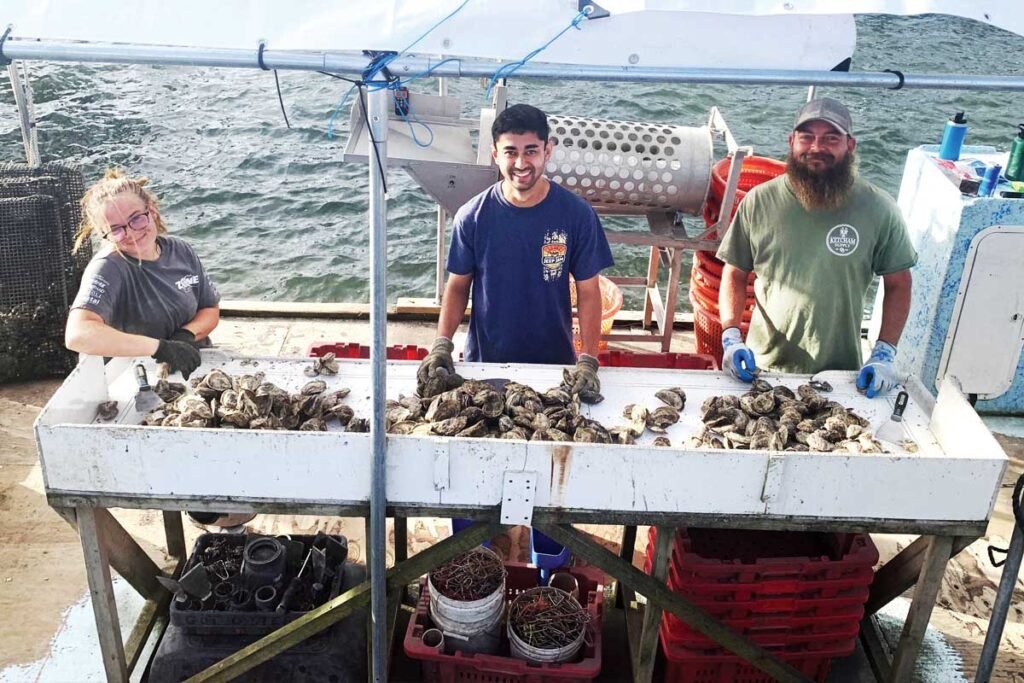
The main task for the day is harvesting. Lifting a cage and extracting a flat bag turns out to be quite labor-intensive. Sea creatures cling to the cage structures, surrounded by seaweed, crabs, and tiny fish. “Our farm has become a floating reef,” Smith observes.
The bags’ contents are processed through a rotating cylinder, which sorts smaller oysters and channels those ready for harvest. Some of these smaller oysters will be donated to Oyster River Ecology, a local restoration initiative aimed at bolstering vital wild populations. “Cultivation” is for consumption, while “restoration” is for ecological health, Smith clarifies.
This somewhat tedious task of scraping and sorting fosters opportunities for discussing personal motivations. Ballard shares his inspiration: “Cultivating an organism that sequesters carbon, filters water, and fosters habitat growth has shown me how much work remains to be done for environmental cleanliness.”
Smith summarizes his sentiments: “Discovering a business that brings joy to people’s lives is truly gratifying. Have you ever seen a photo of someone not smiling while enjoying oysters?”
Second Day: Exploring the Atlantic
On the Indian River Lagoon dock, I met Nicolette Mariano of Treasure Coast Shellfish. As our skiff glided over the clear waters, Nicolette shared her long-standing passion for aquaculture, sparked by volunteering at the Florida Oceanographic Coastal Center when she was just 14. Her Bachelor of Science degree further supports her enthusiasm for her career. “There’s nothing quite like being out on the water at dawn—absorbing all the sights and sounds… the ospreys, dolphins, and manatees breaching for air,” she says.
At the dock, her team donned slickers and began sorting; any damaged oysters were tossed into the shallows, attracting various fish species. Mariano noted the local advantages brought by the farm: “The oysters provide a remarkable vertical habitat for young organisms; our farm effectively operates as its own ecosystem. Additionally, we’ve generated several jobs for individuals in our community, regardless of age.”
The Hurdles
Facing challenges such as mortality events and complex regulations can be daunting, but the most significant obstacle is often the weather. Hurricanes can devastate farms, as Smith experienced when Hurricane Helene destroyed a year’s worth of labor. “It requires persistence, hard work, creativity, resilience, and adaptability. We just find ways to navigate through the hurdles and push ahead,” he remarked.
The Florida Shellfish Aquaculture Association provides community support, with Executive Director Adrianne Johnson expressing their commitment: “Shellfish farmers are some of the hardest working, most resilient, and resourceful individuals I know. We aim to elevate this incredible, emerging industry in the South and invite everyone to join us. Try a southern oyster, support a local farmer, and savor the difference.”
Despite the variety of challenges, Ballard from Calusa articulates his sentiments along with other farmers: “I wouldn’t exchange this job for a million dollars.”
This article was originally featured in the November/December 2025 issue of Thewindowsclubs magazine (U.S. edition).