The reality is stark and inescapable: significant inequities between men and women remain prevalent. It’s difficult to engage with current events without feeling a sense of despair over setbacks regarding women’s rights, threats to their safety, and the ongoing economic struggles they face.
These gender-based inequalities are an issue rooted in the hierarchy of decision-making power. Despite some advancements, women represent only 28 percent of the U.S. Senate. In state legislatures, their representation stands at 29.9 percent in state senates and 33.7 percent in state houses or assemblies.
Likewise, progress toward closing the wage gap has stagnated, with women currently earning just 82 cents for every dollar earned by men—a figure that has shown little improvement over the last two decades.
Clearly, action is essential. While it’s easy to feel disheartened, now is a critical moment for champions of women’s rights to make their voices heard.
Women in the Workforce
WEDO is at the forefront of advocating for women’s rights amid a complex and evolving landscape. Established in 1991 by activists Bella Abzug and Mim Kelber, WEDO has served as a pioneering global advocacy organization dedicated to women’s empowerment for over three decades.
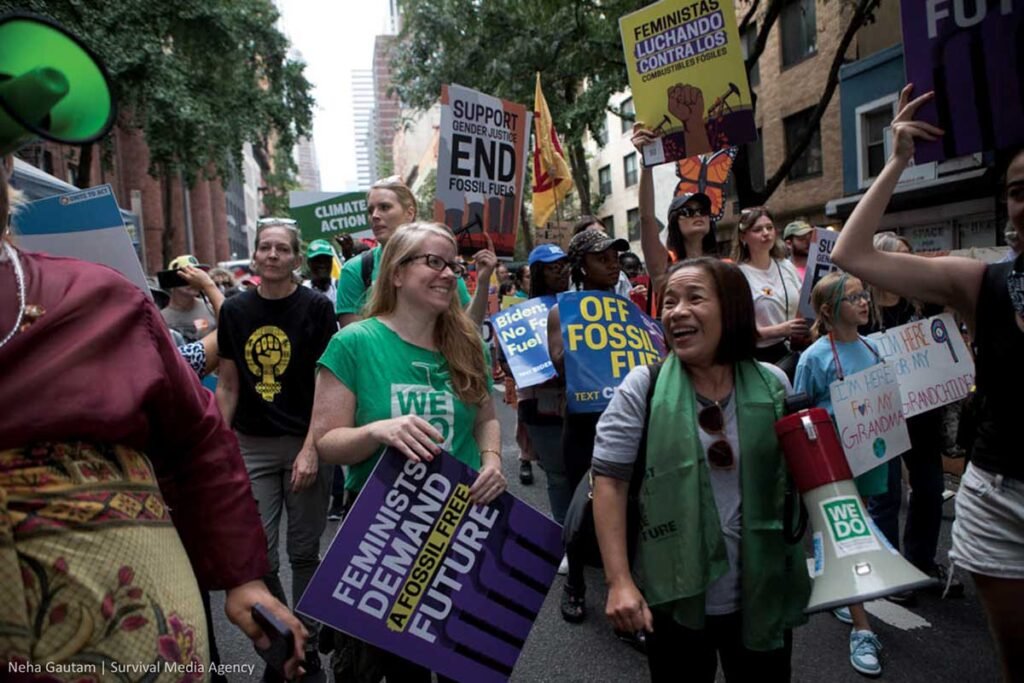
WEDO has engaged in various initiatives such as conferences, actions, fundraising, knowledge dissemination, and outreach to enhance women’s rights, promote gender equality, and incorporate feminist viewpoints into discussions around environmental justice and sustainability.
Executive Director Bridget Burns states, “Our mission revolves around shifting power, resources, and perceptions. We aim to transform representation and ensure marginalized voices have access to these crucial spaces, as we believe policy change follows representation change.”
The organization centers its efforts around four key pillars: Advocacy and Influence, Capacity Building and Training, Knowledge Production and Outreach, and Resource Distribution. This comprehensive strategy includes directing financial resources, elevating feminist voices on global issues, and supporting marginalized communities and solutions.
A critical aspect of WEDO’s initiative is recognizing the interconnectedness of women’s economic freedom, climate change, sexual health, and personal safety.
“Our approach is deeply systemic; we understand that issues are not isolated, but rather deeply intertwined,” Burns explains. “Addressing climate justice also necessitates addressing gender justice. By bringing grassroots feminists from various regions and communities together, we enable them to recognize the shared nature of their struggles.”
Mothering Mother Earth
A critical focus of WEDO’s advocacy is the existential threat that climate change poses. By bringing attention to feminist viewpoints regarding this crisis, WEDO facilitates the dissemination of innovative ideas and insights that could significantly enhance the fight for a sustainable planet.
Studies indicate that women may have an advantage in advocating for climate action, particularly at the community level. Reports suggest that women exhibit a greater awareness of the personal threats posed by global warming.
Yet, funding dedicated to women’s climate advocacy remains scarce. According to a report by the Generation Equality Action Coalition on Feminist Action for Climate Justice, merely 3 percent of philanthropic environmental funding goes to support women’s environmental initiatives. Furthermore, women in the scientific realm face significant barriers, including those linked to race, nationality, and language proficiency.
WEDO seeks to amplify the voices of Indigenous women, who are often the most impacted by climate injustices. “We’ve found that Indigenous traditional knowledge offers unique perspectives that align more harmoniously with sustainable living,” explains Burns.
Research corroborates this perspective, as a UN report has indicated that Indigenous Peoples should play a crucial role in combating climate change, especially Indigenous women, who are essential custodians of natural resources.
However, these women frequently encounter obstacles in gaining their rightful place in these critical discussions. At the recently concluded COP28 UN Climate Change Conference in 2023, women comprised only 34 percent of the delegates—a modest increase of just 3 percent from 2008.
Raise Your Voice
The mission of WEDO is clear: every woman, especially those directly affected by climate change, deserves a place in the conversation. For over a decade, the Women Delegates Fund has empowered more than 200 women from climate-sensitive nations to voice their concerns in climate discussions such as COP28.
One crucial aspect of WEDO’s strategy is not just providing platforms but equipping women with the training necessary to navigate spaces that have historically excluded them. “It’s not merely about including people in meetings,” Burns emphasizes. “We provide extensive training, capacity-building, and support to help individuals understand how to effectively participate in these spaces.”
Moving Forward, Together
WEDO envisions equitable solutions to climate change and gender justice not merely as goals, but as necessities. “We engage in extensive advocacy to ensure that we don’t simply transition from one economy exploiting unpaid labor and gender inequalities to another, even if it’s renewable, that perpetuates the same injustices and inequities that fail to serve communities,” Burns notes.
Throughout the continuous process of advocacy, Burns believes that community strength is essential for instigating significant change. “Powerful movements that foster resilience are crucial, which is why we prioritize collective advocacy,” she states.
As WEDO remains committed to its mission of combating fossil fuel dependency, promoting innovative solutions from women in underrepresented nations, resisting corporate greed, and advocating for systemic reforms in all decision-making arenas, Burns remains hopeful that a brighter future is achievable, taking each day as it comes and celebrating victories along the way. “We are committed to practicing the politics of hope,” she asserts.