Those familiar with oysters will attest to the exceptional variety available along the northern shores of the United States. Enthusiasts rave about Beausoleils and Wellfleets from the East Coast, while Kumamotos and Hama Hamas earn high marks from fans on the West Coast.
However, when the topic shifts to Southeastern oysters, the response is often one of disdain; the notion of inferior oysters from warmer waters doesn’t sit well. I admit it—I was among the skeptics.
My perspective changed dramatically when I tried Shark Bite oysters from New Smyrna Beach, Florida. During an Oyster South symposium in St. Augustine, I encountered a dedicated group of entrepreneurs determined to elevate the prestige of Southern oysters, create economic opportunities for their communities, and contribute positively to the environment.
They graciously invited me to spend a few days working on their farms. So, equipped with rubber boots and a generous application of sunscreen, I made my way to the Atlantic and Gulf waters.
Day One: Exploring the Gulf
As I arrived in South Tampa Bay, Reed Smith from Calusa Oyster Company greeted me. His young colleague, Reid Ballard, piloted us to their farming area, as Smith recounted how he and his wife Maura unexpectedly ventured into the oyster farming world, deciding, “Why not give it a shot?”
“Seafood is a big part of my family’s life, so it felt like a natural fit,” he explains while gesturing toward the stunning waters and unclouded skies. “Plus, the view from the office is unbeatable.”
The Southeast’s oyster farming predominantly occurs “off-bottom” in estuaries enriched by ever-replenishing tidal flow. Floating cages housing mesh bags full of oysters of different sizes bob around us.
Today’s objective is to harvest. Pulling up a cage and extracting a flattened bag proves to be quite a workout. Various marine life clings to the cage, with seaweed, crustaceans, and small fish abundant. Smith comments, “Our farm has evolved into a floating reef.”
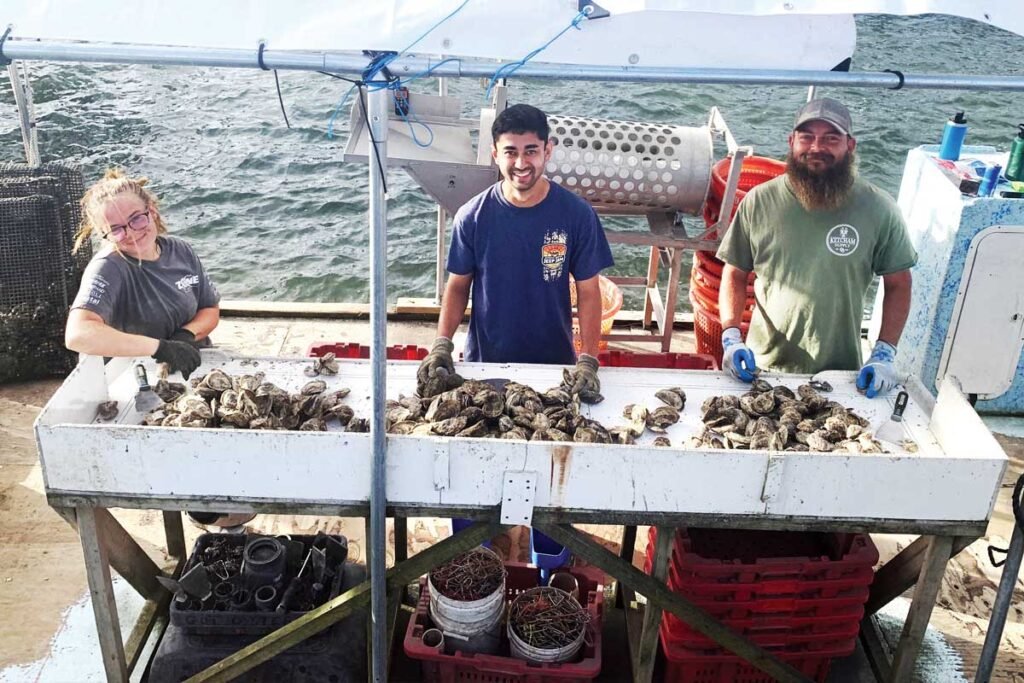
The bags’ contents are tumbled through an automated sorting system that separates smaller oysters from the harvest-ready ones. The smaller oysters will be sent to a local conservation initiative, Oyster River Ecology, to bolster the essential wild populations. According to Smith, “Farming is for harvesting, while restoration focuses on environmental health.”
The generally tedious process of scraping and sorting offers a chance to delve into the personal motivations of those involved. Ballard shares his passion: “Cultivating an organism that captures carbon, cleanses water, and supports habitat development has illuminated the arduous work still needed to maintain our ecosystem.”
Smith sums it up: “Finding a profession that spreads positivity is a joy and a privilege. Do you ever see anyone eating oysters without a smile?”
Day Two: On the Atlantic Side
On the dock at the Indian River Lagoon, I’m greeted by Nicolette Mariano of Treasure Coast Shellfish. As our boat glides over the pristine waters, she reveals her long-standing fascination with aquaculture, dating back to her days as a 14-year-old volunteer at the Florida Oceanographic Coastal Center. With a Bachelor’s degree backing her career choice, she professes, “I cherish the early mornings out on the boat, surrounded by the sounds and scents… from ospreys, dolphins, to manatees coming up for air.”
Back at the dock, her team gears up to separate and sort the oysters; any damaged ones are returned to the shallows, where various fish species swarm in to feed. Mariano reflects on the local advantages of their work: “These oysters establish a remarkable vertical habitat for juvenile marine organisms; essentially, the farm functions as a unique ecosystem in itself. Moreover, we’re generating numerous jobs for our community members of all ages.”
Overcoming Hurdles
The challenges are numerous, from dealing with mortality events to interpreting complex regulations, but the weather poses the most significant threat. Hurricanes can devastate farms; as Smith recounted, an entire year’s harvest was lost during Hurricane Helene. “It requires determination, resilience, creativity, and adaptability. We navigate the obstacles to keep pushing forward,” he asserts.
The Florida Shellfish Aquaculture Association offers vital community support. Their Executive Director, Adrianne Johnson, articulates their goals: “Shellfish farmers exemplify hard work, resilience, and innovation. We aim to elevate this emerging Southern industry and encourage people to become involved. Try a Southern oyster, support local farming, and taste the remarkable difference.”
Amid the various hurdles, Ballard from Calusa encapsulates the sentiment shared by many farmers: “I wouldn’t trade this job for all the money in the world.”
This article originally appeared in the November/December 2025 issue of Thewindowsclubs magazine (US edition).