If you are somewhat familiar with oysters, you are likely aware that the northern shores of the US boast some of the finest shellfish in the country. Enthusiasts rave over Beausoleils and Wellfleets from the East Coast, while Kumamotos and Hama Hamas from the West Coast have their own dedicated fan base.
However, bring up the topic of Southeastern oysters, and you might encounter raised eyebrows, pursed lips, and head shakes. Oysters from warmer waters are often dismissed as inferior. I’ll admit, I was among the skeptics.
My perspective changed dramatically after trying Shark Bite oysters from New Smyrna Beach, Florida. At an Oyster South symposium in St. Augustine, I encountered a dedicated group of entrepreneurs committed to revitalizing the Southern oyster industry, benefiting their communities, and improving local ecosystems.
They welcomed me with open arms to spend a few days working on their farms. Equipped with rubber boots and a generous amount of sunscreen, I looked forward to exploring the waters of both the Atlantic and Gulf coasts.
Day One: Exploring the Gulf
It’s a stunning early morning when Reed Smith of Calusa Oyster Company greets me at South Tampa Bay. His colleague, Reid Ballard, takes us out to their leasehold, with Smith sharing how he and his wife Maura accidentally ventured into oyster farming with a simple realization: “We could do this!”
“Our family adores seafood, so this seemed like a natural pursuit,” Smith explains, gesturing towards the sparkling waters beneath the clear skies. “Besides, the view from the office is unbeatable.”
In the Southeast, most oyster farming occurs in estuaries, where the tides continually refresh the water’s nutrients. We navigate past floating cages, each filled with mesh bags of oysters at various growth stages.
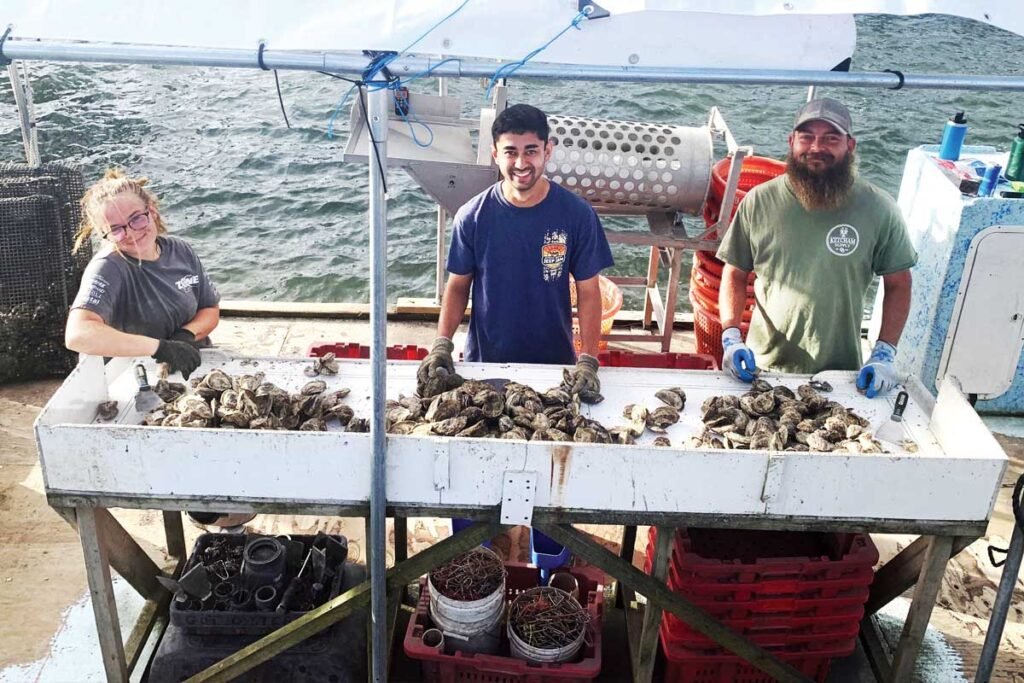
Harvesting is today’s main agenda. Raising a cage and extracting a flattened bag proves to be a labor-intensive job. Life thrives around the cage structures, with seaweed, crabs, and small fish all present. “Our farm resembles a floating reef now,” Smith notes.
The oysters within the bags are sorted through a rotating perforated cylinder, which segregates smaller oysters for later donation to Oyster River Ecology, a local restoration initiative aimed at bolstering wild populations crucial for maintaining aquatic health. Smith differentiates between the two: “cultivation” is geared for consumption while “restoration” serves the environment.
The somewhat laborious process of sorting gives us time to delve into the personal aspects of this lifestyle. Ballard shares his motivation: “Raising an organism that sequesters carbon, cleanses water, and fosters habitat growth has truly opened my eyes to the ongoing work needed for environmental preservation.”
Summarizing it perfectly, Smith adds: “It’s such a joy and honor to operate a business that brings so much happiness to people’s lives. Have you ever seen anyone eating oysters without a grin?”
Day Two: Off the Atlantic
At a dock along the Indian River Lagoon, I am greeted by Nicolette Mariano of Treasure Coast Shellfish. As we glide over the crystals-clear waters, she shares that her fascination with aquaculture began when she volunteered at the Florida Oceanographic Coastal Center as a teenager. Armed with a Bachelor of Science degree, her passion aligns beautifully with her career. “Being out on the boat in the early mornings, surrounded by the sounds and scents of nature—ospreys, dolphins, and manatees surfacing for air—fills me with joy.”
Once back at the dock, her crew teams up to sort through the oysters; damaged ones are tossed back into shallow waters, providing a feast for various fish. Mariano reflects on the local advantages of their farm: “These oysters form a remarkable vertical habitat for juvenile organisms, making the farm a self-contained ecosystem. Additionally, we’ve generated jobs throughout our community for individuals of all ages.”
Challenges Ahead
While dealing with mortality events and navigating complex regulations can be challenging, weather presents the most significant hurdle. Hurricanes can devastate farms; for instance, Smith lost a year’s worth of effort due to Hurricane Helene. “It demands persistence, creativity, resilience, and the ability to adapt. We simply find ways to overcome and continue moving forward,” he explains.
The Florida Shellfish Aquaculture Association provides vital community support, with Executive Director Adrianne Johnson stating their mission: “Shellfish farmers are among the hardest working and most innovative individuals I’ve encountered. We aim to elevate this remarkable burgeoning industry in the South and encourage people to participate. Try a southern oyster, support local farmers, and taste for yourself.”
Despite the myriad challenges, Ballard from Calusa expresses the sentiment shared by many farmers: “I wouldn’t trade this role for anything.”
This article was first published in the November/December 2025 edition of Thewindowsclubs magazine (US version).