For those familiar with oysters, the northern shores of the US are famous for their tasty shellfish varieties. Enthusiasts rave about Beausoleils and Wellfleets from the East, while Kumamotos and Hama Hamas from the West hold a special place in their hearts.
However, when the conversation shifts to oysters from the Southeast, it often elicits skepticism, with many dismissing them as inferior products from warmer waters. Admittedly, I used to share this sentiment.
But a chance introduction to Shark Bite oysters from New Smyrna Beach, Florida, transformed my perspective. During an Oyster South symposium in St. Augustine, I encountered a dedicated group of entrepreneurs committed to elevating the Southern oyster’s reputation, benefiting their communities, and improving the local ecosystem.
Invitations followed to spend a couple of days working on the farms, and with rubber boots packed and sunscreen applied, I eagerly made my way to the Atlantic and Gulf waters.
Day One: Gulf Adventures
On a stunning early morning, Reed Smith from Calusa Oyster Company greets me at South Tampa Bay. His partner, Reid Ballard, navigates us to their leasehold as Smith shares how he and his wife, Maura, serendipitously discovered oyster farming, saying, “Why not give it a try?”
“My family has a deep love for seafood, so it felt like a natural path,” Smith explains, gesturing towards the serene waters and clear skies. “And the view from the office is pretty hard to beat.”
Much of the oyster farming in the Southeast is “off-bottom” in estuarine areas where tides continuously refresh nutrients in the water. Ahead of us, floating cages hold mesh bags containing oysters at different growth stages.
Our main task for the day is harvesting. Pulling a cage up and extracting a flattened bag proves to be quite the workout. The cages are alive with marine life, with seaweed, crabs, and tiny fish all around. As Smith remarks, “Our farm resembles a floating reef now.”
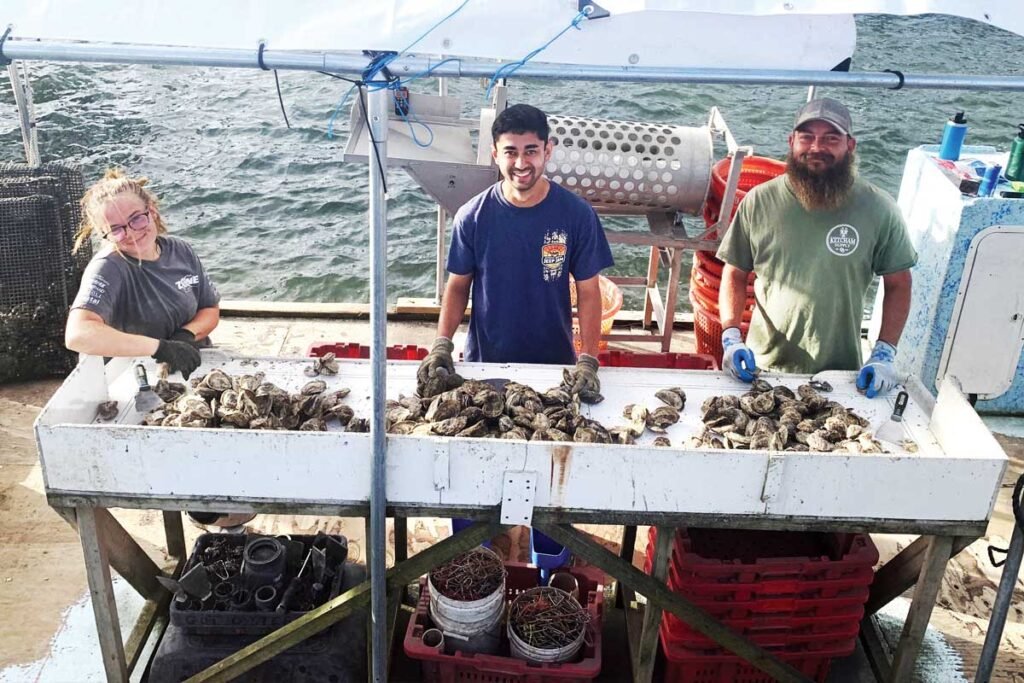
The bags’ contents are sifted through a rotating perforated cylinder, separating smaller oysters from those ready for harvesting. Smaller oysters will be donated to a local initiative, Oyster River Ecology, to aid wild populations essential for the ecosystem’s health. Smith differentiates between the two: “cultivation” is for consumption and “restoration” is for environmental support.
This somewhat laborious process allows for personal insight into this vocation. Ballard expresses his motivation: “Cultivating an organism that captures carbon, cleanses water, and supports habitat development has made me aware of how much work is still needed to maintain environmental health.” Smith encapsulates the joy of their work: “Finding a profession that spreads positivity to others is truly rewarding. After all, have you ever seen a picture of someone not smiling while enjoying oysters?”
Day Two: Atlantic Insights
I am welcomed to the Indian River Lagoon dock by Nicolette Mariano of Treasure Coast Shellfish. As our boat glides over the sparkling waters, she recounts how her interest in aquaculture began as a 14-year-old volunteer at the Florida Oceanographic Coastal Center. Her Bachelor of Science degree complements her passion for her work. “Being on the boat in the peaceful morning, immersed in the sounds and sights of nature—ospreys, dolphins, manatees—is pure bliss,” she notes.
At the dock, her team prepares to sort and separate; any damaged oysters are tossed into shallow waters where a variety of fish gather to feed. Mariano reflects on the local impact of their farm. “The oysters provide an intricate vertical habitat for juvenile species; it’s like its own little ecosystem. Plus, we’ve generated numerous jobs in the community for all ages.”
Navigating Challenges
Farmers face complex regulations and periodic mortality events, but adverse weather conditions are the most significant trials. Hurricanes can devastate farms, as Smith at Calusa experienced when an entire year’s labor was lost due to Helene. “It requires determination, creativity, resilience, and flexibility. We just navigate through the difficulties and keep moving forward,” he explains.
Support comes from the Florida Shellfish Aquaculture Association, whose Executive Director, Adrianne Johnson, emphasizes their goal: “Shellfish farmers are among the most industrious, resilient, and innovative individuals. We aspire to uplift this burgeoning industry in the South and encourage people to get involved. Savor a southern oyster, back a local farmer, and experience the distinction.”
Despite the ongoing challenges, Ballard from Calusa conveys the sentiment of his fellow farmers: “I wouldn’t exchange this job for anything, not even a million dollars.”
This piece first appeared in the November/December 2025 edition of Thewindowsclubs magazine (US edition).