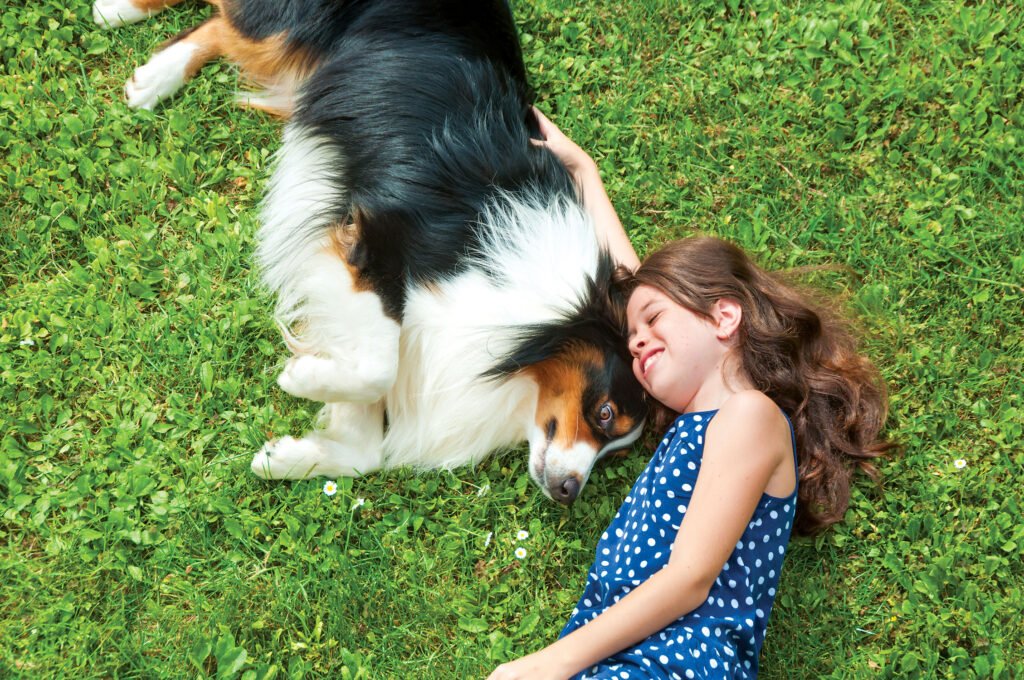
Two years ago, the Arbo family welcomed Nugget into their home. While Australian shepherds are renowned for their high energy levels and the need for daily physical and mental stimulation, Nugget has a knack for relaxing when it’s time to wind down in the house.
Nine-year-old Kale Arbo’s mother, Jen Arbo, who also has a cat and four chickens, shares, “There’s a wonderfully relaxed and natural rapport between the two of them, and I believe Nugget has become a significant part of Kale’s understanding of what our family represents.”
Alongside the valuable lessons Kale has picked up from pet ownership—such as the duties of feeding and training as well as coping with the loss of their previous dog—growing up with pets provides numerous lasting advantages for children and strengthens the family bond as a whole.
Pets as Family Members
Dr. Christina Brown, a social-personality scientist and professor at Arcadia University, has conducted research on how pets positively impact human health and well-being.
According to Dr. Brown, pets provide more than just companionship. They can offer social support comparable to that of a spouse, sibling, or close friend, and pet owners often regard their animals as integral family members. Notably, the greatest benefits arise when owners feel a strong bond with their pets.
“Psychological studies indicate that having multiple forms of social support enhances overall well-being. Pets contribute positively to this,” explains Dr. Brown. “In times of rejection or loneliness, even the thought of our pets can uplift us.”
Moreover, it is important to recognize that pets enrich a household. Dr. Brown adds, “Crucially, pets enhance human relationships rather than detract from them. They serve as an additional source of support linked to improved well-being.”
The Role of Pets in Child Development
Integrating pets into a household significantly influences early childhood development. Research has shown that children with pets tend to exhibit better impulse control and show lower levels of stress, anxiety, and depression. Additionally, having pets may decrease the likelihood of developing allergies.
Dr. Brown emphasizes that the responsibility associated with caring for a pet can impart enduring benefits, indicating that allowing children to take care of various pet needs can be advantageous for both parties.
The link between physical and mental health is also significant, and growing up with pets can support both aspects. In particular, dogs require regular walks, providing a great impetus for children to engage in physical activities. “For mental health,” Dr. Brown notes, “there’s considerable research indicating the significant benefits of physical activity.”
Building Strong Social Connections
Nugget is not the first dog to be part of the Arbo family. Several years ago, Kale experienced the loss of their 16-year-old Shiba Inu, Mooki, who faced significant health challenges, leading to the family’s decision regarding euthanasia. Jen and her husband chose to include Kale in this challenging process, thereby teaching him about both euthanasia and responsible pet ownership.
After deciding to adopt another dog, Kale had to adjust to a new pet with different needs, including greater attention and exercise. “It was transformative for Kale to realize Nugget was a different kind of dog,” remarks Jen. It has since become common for Kale to engage Nugget in conversations about video games or describe the cat’s antics, with Nugget happily participating. “Nugget won’t ask him to be quiet,” adds Jen.
Conversing with pets, according to Dr. Brown, is highly beneficial as it acknowledges that animals have their own thoughts and autonomy. “While we might feel silly talking to our pets, that very act of connecting with them as fellow beings is what allows pets to positively influence our lives,” Dr. Brown explains.
The Significance of Responsible Pet Ownership
Dr. Brown advocates for animal rights, emphasizing that while pets enhance our lives, it is equally important to consider what responsibilities we owe them. “Pets can indeed benefit us, but we owe it to them to provide care in return,” she states.
In essence, pet ownership involves significant commitments and responsibilities, including ensuring proper care and training. This is likely one of the primary lessons for both children and parents alike.