For those familiar with oysters, the northern U.S. coasts are famous for their exquisite shellfish varieties. Enthusiasts rave about Beausoleils and Wellfleets from the East Coast, while on the West Coast, Kumamotos and Hama Hamas are celebrated.
However, bringing up the oysters from the Southeast often results in disdain—who would want second-rate oysters from warmer waters? I’ll admit, I used to share this skepticism.
That changed when I tasted Shark Bite oysters sourced from New Smyrna Beach in Florida. During the Oyster South symposium in St. Augustine, I met a dedicated group of entrepreneurs committed to improving the reputation of Southern oysters, benefiting their communities, and fostering environmental gains.
I received warm invitations to spend a couple of days working on their farms. Equipped with rubber boots and a generous layer of sunscreen, I eagerly ventured towards the waters of both the Atlantic and the Gulf.
Day One: On the Gulf
The day begins with a clear sky as Reed Smith from Calusa Oyster Company greets me in South Tampa Bay. With his colleague Reid Ballard at the helm, we cruise out to their lease site. Smith reveals that he and his wife Maura discovered oyster farming almost by accident, realizing, “Hey, we could do that!”
“Our family has a deep appreciation for seafood, making it a logical venture,” he explains while gesturing at the sparkling waters and unblemished blue sky. “Plus, the view from the office is unbeatable.”
Most oyster farming operations in the Southeast are carried out “off-bottom” in estuarine environments where currents continually supply nutrients. We navigate past floating cages, each filled with mesh bags of oysters at different growth stages.
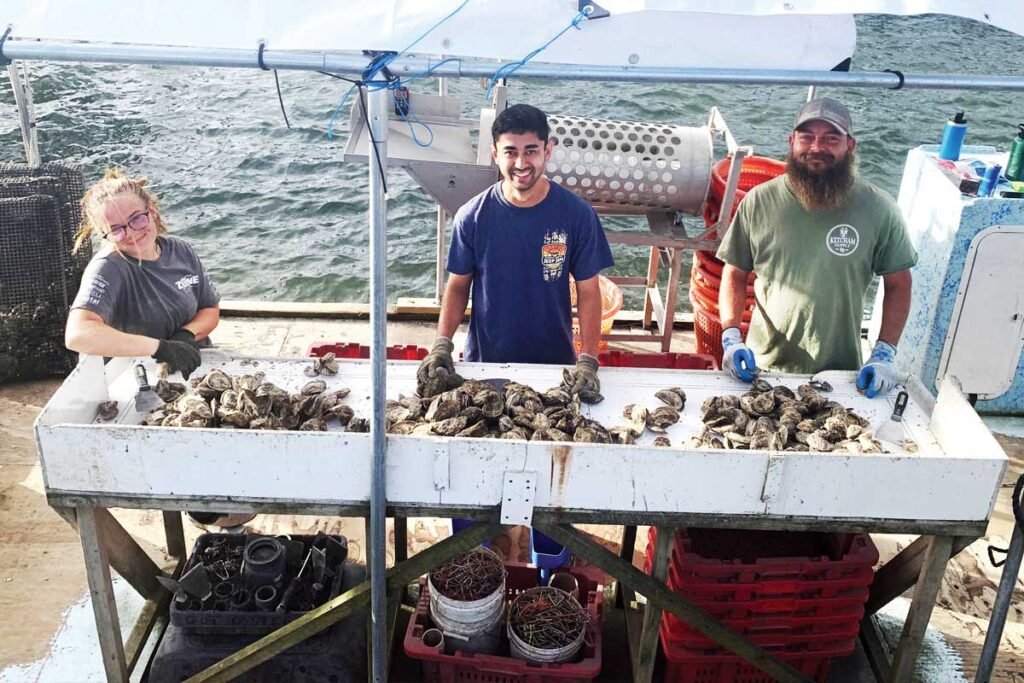
Today’s main focus involves harvesting. Recovering a cage and extracting a flattened bag proves to be quite labor-intensive. The cages teem with marine life, featuring an array of seaweed, crabs, and small fish. Smith describes it beautifully: “Our farm resembles a floating reef now.”
The oysters are processed through a rotating cylinder that sorts out the smaller ones, with those ready for consumption being funneled off. Some of the smaller oysters are donated to Oyster River Ecology for local restoration efforts, highlighting a distinction Smith emphasizes: “cultivation” for consumption versus “restoration” for ecological health.
The methodical nature of sorting gives rise to deeper conversations about the motivations behind this lifestyle. Ballard shares his passion, stating, “Cultivating an organism that sequesters carbon, cleans water, and fosters habitat growth has revealed the ongoing efforts needed to maintain our environment’s health.”
In summary, Smith reflects: “It’s fulfilling to find a career that positively impacts people’s lives. Do you ever spot a picture of someone not beaming while they’re indulging in oysters?”
Day Two: On the Atlantic
On the Indian River Lagoon dock, I am greeted by Nicolette Mariano from Treasure Coast Shellfish. As we glide over the clear waters, she shares her long-standing fascination with aquaculture, ignited when she volunteered at the Florida Oceanographic Coastal Center at just 14. Armed with a Bachelor of Science degree, she finds enjoyment in her field. “There’s nothing quite like being on a boat early in the morning, immersed in the sounds and scents of nature—the ospreys, dolphins, and the manatees surfacing for air.”
Upon returning to shore, her crew begins sorting; damaged oysters are cast into the shallow water, attracting various fish species. Mariano highlights the farm’s local impact: “Oysters provide a dynamic, vertical habitat for juvenile marine life; effectively making the farm a self-sustaining ecosystem. We’ve also generated numerous jobs for a diverse range of individuals in our area.”
Challenges Faced
While navigating complex regulations and mortalities can be challenging, the most significant hurdle comes from weather. Hurricanes can devastate farms, as Smith from Calusa explains—his entire year’s harvest was lost to Hurricane Helene. “It requires grit, hard work, creativity, resilience, and the ability to adapt. We just find ways to move forward and keep pushing.”
Support from the Florida Shellfish Aquaculture Association has been instrumental in the community. Executive Director Adrianne Johnson highlights their commitment: “Shellfish farmers exemplify hard work, resilience, and ingenuity. We aspire to elevate this remarkable industry in the South and invite everyone to participate. Support your local farmers and try a southern oyster to experience the difference.”
Despite the various challenges they encounter, Ballard from Calusa echoes the sentiment shared by many farmers: “I wouldn’t trade this work for anything.”
This piece originally appeared in the November/December 2025 edition of Thewindowsclubs magazine (U.S. edition).