For those familiar with oysters, it’s well known that the northern coasts of the U.S. are distinguished by their exquisite shellfish varieties. East Coast enthusiasts rave about Beausoleils and Wellfleets, while West Coast fans celebrate Kumamotos and Hama Hamas.
However, when the conversation shifts to Southeastern oysters, reactions often include wrinkled noses and disapproving shakes of the head. Warm water oysters seen as inferior? Not on my plate of crushed ice. I must admit: I was once among those skeptics.
It was a fortunate encounter with Shark Bite oysters from New Smyrna Beach, Florida, that completely transformed my perception. At an Oyster South symposium in St. Augustine, I met a dedicated group of entrepreneurs who are committed to revitalizing the reputation of Southern oysters, adding value to their communities, and improving the local environment.
Extending gracious invitations, they offered me a chance to spend a few days working on the oyster farms. With rubber boots packed and sunscreen applied, I set off to explore the waters of the Atlantic and the Gulf.
Day one: On the Gulf
On a lovely early morning, Reed Smith of Calusa Oyster Company greets me in South Tampa Bay as his co-worker, Reid Ballard, takes us out to their leasehold. Smith shares how he and his wife Maura serendipitously ventured into oyster farming, thinking, “That looks fun!”
“We’re a seafood-loving family, so it made perfect sense,” says Smith, gesturing towards the shimmering waters and the clear skies. “And truth be told, the office view is unbeatable.”
Oyster farming in the Southeast primarily occurs “off-bottom” within estuaries, with tides continuously replenishing nutrients. We spot floating cages ahead, each containing mesh bags filled with oysters at different growth stages.
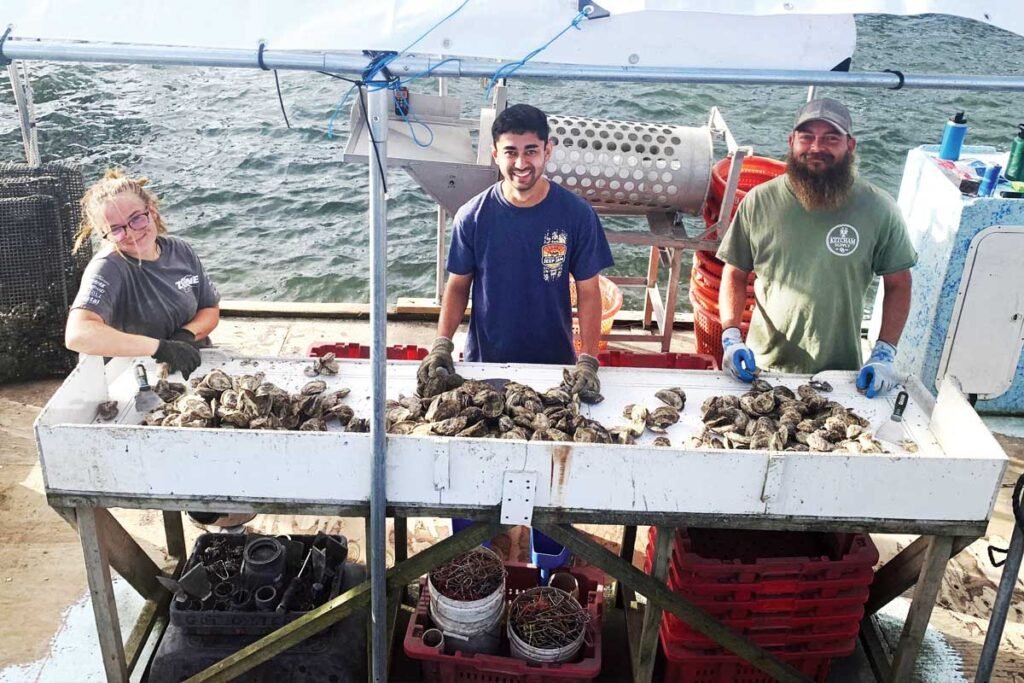
Our main task for the day is harvesting. Hoisting a cage and extracting a flattened bag proves to be quite a workout, with marine life clinging to the cage structures—seaweed, crabs, and tiny fish abound. Smith mentions, “Our farm has evolved into a floating reef.”
The oysters from the bags are processed through a rotating perforated cylinder that sorts out the smaller specimens, directing those that are ready for harvest. Some of the smaller oysters will be contributed to a local restoration initiative, Oyster River Ecology, to bolster wild populations essential for the health of these waters. Smith distinguishes the two: “cultivation” is for consumption, while “restoration” benefits the environment.
This somewhat laborious task of cleaning and sorting provides time for personal reflections. Ballard shares his passion: “Cultivating an organism that sequesters carbon, cleans water, and fosters habitat growth has illuminated how much work lies ahead for maintaining a clean environment.”
Smith encapsulates the sentiment perfectly: “Finding a profession that spreads joy is such a rewarding experience. Have you ever seen a frown on someone’s face while enjoying oysters?”
Day two: On the Atlantic
Upon arriving at a dock on the Indian River Lagoon, I am greeted by Nicolette Mariano of Treasure Coast Shellfish. As our small boat glides across the crystal waters, she shares her long-standing passion for aquaculture, ignited when she volunteered at the Florida Oceanographic Coastal Center at just 14 years old. Her Bachelor of Science degree bolsters her enthusiasm for this field. “I love early mornings on the boat—enjoying the sounds and scents… the ospreys, dolphins, and manatees surfacing for air,” she says.
Back at the dock, her crew dons slickers and begins sorting; any damaged oysters are tossed into the shallow waters, attracting various fish species. Mariano highlights the local advantages of their farm: “The oysters offer a remarkable vertical habitat for young organisms; indeed, the farm serves as a complete ecosystem. Additionally, we’ve created numerous jobs for community members across age groups.”
Challenges Ahead
Facing mortality events and navigating complex regulations can be challenging, but weather conditions pose the largest hurdles. Smith from Calusa shared that an entire year’s yield was devastated by Hurricane Helene. “It demands persistence, dedication, creativity, resilience, and the ability to adapt. We just find ways to navigate around the issues and keep moving forward.”
The Florida Shellfish Aquaculture Association provides community support, with Executive Director Adrianne Johnson emphasizing their mission: “Shellfish farmers are among the most dedicated, resilient, and innovative individuals I know. We aim to elevate this exciting and growing industry in the South, encouraging people to become a part of it. Sample a Southern oyster, support local farmers, and enjoy the difference.”
Despite numerous challenges, Ballard from Calusa articulates the sentiment shared among fellow farmers: “I wouldn’t exchange this job for any amount of money.”
This story first appeared in the November/December 2025 issue of The Windows Clubs magazine (U.S. edition).