For those familiar with oysters, the northern shores of the United States are celebrated for their exquisite shellfish varieties. Gourmets lavish attention on Beausoleils and Wellfleets from the Atlantic, while the praises of Kumamotos and Hama Hamas from the Pacific are sung with equal fervor.
However, when the conversation shifts to oysters from the Southeast, reactions often include wrinkled noses and dismissive shakes of the head. Subpar oysters from warmer waters? Not on my ice-filled platter! I must admit, I once held similar views.
Then, a fortunate meeting with Shark Bite oysters from New Smyrna Beach, Florida, transformed my perspective entirely. At an Oyster South symposium held in St. Augustine, I met an enthusiastic group of dedicated entrepreneurs committed to reviving the reputation of Southern oysters, providing value to their communities, and improving the local ecology.
I received a warm invitation to spend a couple of days participating on the farms. Equipped with rubber boots and ample sunscreen, I excitedly set off toward the Atlantic and Gulf waters.
Day One: Gulf Experience
On a beautiful early morning, I was welcomed by Reed Smith of Calusa Oyster Company in South Tampa Bay. His young partner, Reid Ballard, navigated us to their designated area while Smith shared how he and his wife, Maura, serendipitously decided to venture into oyster farming, exclaiming, “Hey, we could do that!”
“Our family has a passion for seafood, so pursuing this seemed like a logical step,” Smith commented, gesturing at the sparkling waters and azure skies. “And this office view is hard to top.”
In the Southeast, oyster farming primarily occurs “off-bottom” within estuarine waters where tides consistently rejuvenate nutrient levels. We passed floating cages containing mesh bags of oysters at different growth stages.
This session’s main focus was the harvest. Raising a cage to extract a flattened bag turned into quite the workout. The cage teemed with marine life: seaweed, crabs, and tiny fish surrounded us. Smith noted, “Our farm has evolved into a floating reef.”
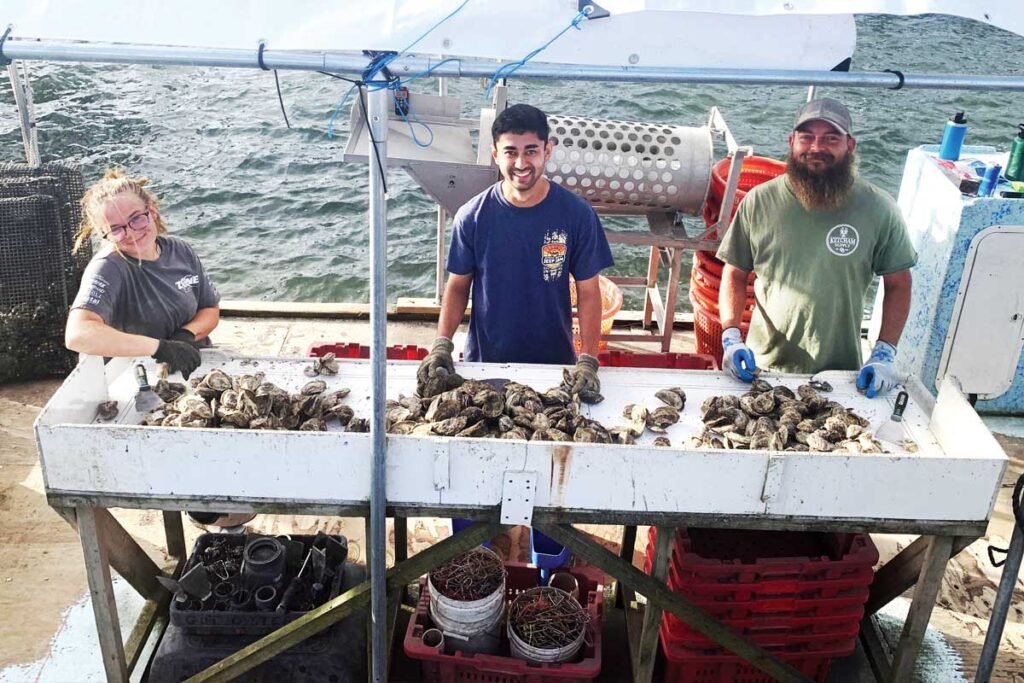
The contents of our bags were rolled through a rotating perforated tube, separating the smaller oysters and directing the harvest-ready ones further along. Some smaller ones were designated for a local restoration initiative, Oyster River Ecology, aimed at supporting wild oyster populations that are crucial for maintaining water health. Smith emphasized the distinction: “cultivation” is geared for consumption, while “restoration” serves ecological purposes.
Even the arduous task of sorting and cleaning lent itself to personal conversations about this fulfilling lifestyle. Ballard passionately expressed the motivation behind his work: “Cultivating a species that captures carbon, cleanses water, and fosters habitat growth has opened my eyes to the ongoing efforts needed to preserve our environment.”
Smith summarized the sentiment: “It’s a privilege to be part of a business that spreads joy. When are people not smiling while enjoying oysters?”
Day Two: Atlantic Insights
I was introduced to Nicolette Mariano of Treasure Coast Shellfish at a dock on the Indian River Lagoon. As our skiff glided over the clear waters, Nicolette revealed her long-standing fascination with aquaculture, which began when she volunteered at the Florida Oceanographic Coastal Center at just 14 years old. Her Bachelor of Science further fuels her enjoyment of her craft. “I cherish early mornings on the boat, absorbing all the sights and sounds—the ospreys, dolphins, and manatees surfacing for air,” she shared.
Back at the dock, her team equipped themselves and began sorting through oysters. Damaged ones were cast back into the shallow waters, where various fish species swarmed to feed. Mariano spoke of the positive ecosystem benefits that arise from the farm: “Our oysters establish a remarkable three-dimensional habitat for juvenile organisms; the farm is indeed a self-sustaining ecosystem. Additionally, we have generated jobs within our community, engaging people of all ages.”
The Challenges Ahead
While mortality events and intricate regulations can complicate matters, weather remains the principal challenge. Hurricanes can devastate farms; Smith at Calusa lost an entire year’s work due to Hurricane Helene. “It requires determination, hard work, creativity, resilience, and flexibility. We find alternative solutions and keep moving forward,” he noted.
The Florida Shellfish Aquaculture Association, led by Executive Director Adrianne Johnson, provides essential community support. She expresses their objective: “Shellfish farmers are some of the most industrious, adaptable, and innovative people I know. We aim to uplift this incredible emerging industry in the South and encourage others to join in. Try a Southern oyster, support a local farmer, and taste the difference.”
Despite numerous obstacles, Ballard from Calusa succinctly encapsulated the sentiment: “I wouldn’t trade this experience for anything.”
This article first appeared in the November/December 2025 edition of The Windows Club magazine (U.S. edition).