If you’re even somewhat familiar with oysters, you’re likely aware that the northern United States is celebrated for its rich variety of these shellfish. Enthusiasts rave about the Beausoleils and Wellfleets from the East Coast, while Kumamotos and Hama Hamas from the West have their own dedicated fans.
However, when the topic shifts to oysters from the Southeast, many react with skepticism—regarded as subpar and associated with warmer waters. No thank you, they say, as they turn up their noses at the prospect of second-rate shellfish on their ice-laden platters. I’ll admit, I was among those skeptics.
But everything changed for me after a fortuitous introduction to Shark Bite oysters from New Smyrna Beach, Florida, which opened my palate to a different experience. During an Oyster South symposium in St. Augustine, I met a passionate group of dedicated entrepreneurs aiming to uplift the Southern oyster’s image, bring economic value to their communities, and promote environmental restoration.
Through warm invitations, I had the opportunity to spend two days on their farms. Armed with rubber boots and generously applied sunscreen, I set out to explore the Atlantic and Gulf waters.
Day one: On the gulf
As dawn breaks over South Tampa Bay, Reed Smith of Calusa Oyster Company greets me. His enthusiastic assistant, Reid Ballard, takes us out to their leasehold, where Smith shares how he and his wife, Maura, serendipitously discovered oyster farming, prompting the epiphany, “We could do that!”
“MY family loves seafood, so pursuing this seemed natural,” Smith remarks while gesturing to the shimmering waters and clear skies. “Besides, who wouldn’t want to work in such a spectacular office?”
Oyster aquaculture in the Southeast largely happens “off-bottom” in estuarine waters, where nutrient-rich tides consistently flow. Floating cages ahead of us contain mesh bags filled with oysters at various growth stages.
Today, our focus is on harvesting. Pulling up a cage and extracting a compacted bag proves to be quite a workout. The cage is live with marine life, laden with crabs, seaweed, and small fish. “Our farm has become a floating reef,” Smith observes.
As we sort through the harvested bags, we separate smaller oysters, some of which will go on to aid local restoration efforts led by Oyster River Ecology to bolster wild populations essential for aquatic ecosystems. “Cultivation” is intended for eating, while “restoration” is focused on environmental health, Smith explains.
This somewhat labor-intensive activity allows time for deeper conversation. Ballard expresses his commitment, saying, “Growing an animal that sequesters carbon, cleans water, and encourages habitat growth has made me realize there’s so much more work to do to maintain our environment.”
Smith succinctly captures the joy of their endeavor: “It’s a blessing to engage in a profession that spreads happiness. After all, when do you see pictures of people not smiling while eating oysters?”
Day two: On the Atlantic
At the dock of the Indian River Lagoon, I meet Nicolette Mariano of Treasure Coast Shellfish. As we glide smoothly across the shimmering waters, she shares her long-standing interest in aquaculture, which began at the age of 14 during her volunteer work at the Florida Oceanographic Coastal Center, complemented by her academic background in the field. “I cherish early mornings on the boat, embracing the natural sounds and scents…the ospreys, dolphins, and manatees surfacing for air,” she says fondly.
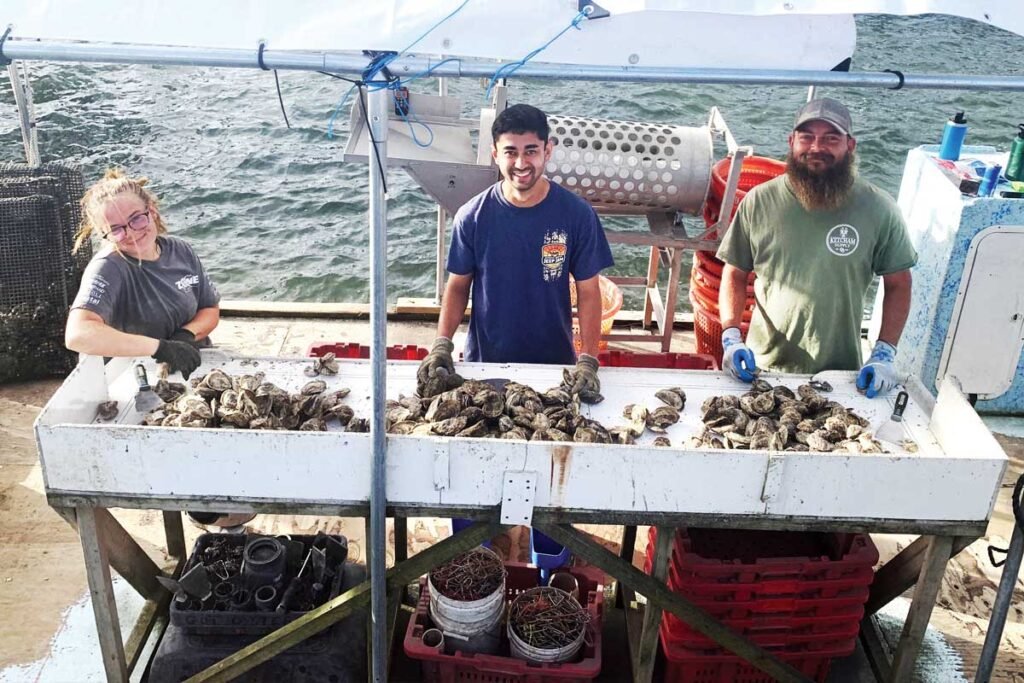
Upon returning to the dock, her team dons slickers and begins sorting through the oysters. Damaged ones are thrown back into the shallows, drawing schools of fish to feed. Mariano emphasizes the community benefits yielded by her farm. “Oysters provide a fabulous vertical habitat for young organisms; they create their own unique ecosystem. Additionally, we’ve generated multiple jobs in our community for individuals of all ages.”
The challenges
While mortality events and intricate regulations can be challenging, unpredictable weather presents the greatest threat. Hurricanes can devastate farms; for instance, Smith experienced a total loss of an entire year’s labor due to Hurricane Helene, saying, “It takes persistence, determination, creativity, resilience, and flexibility. We adapt and persevere.”
The Florida Shellfish Aquaculture Association lends support, with Executive Director Adrianne Johnson underscoring their mission: “Shellfish farmers are some of the most diligent, resilient, and innovative individuals I know. We strive to foster this incredible emerging industry in the South and invite everyone to engage with it. Try a southern oyster, support local farmers, and taste the difference.”
Despite the multitude of hurdles, Ballard from Calusa articulates the sentiment of his peers: “I wouldn’t swap this job for any amount of money.”
This article was originally featured in the November/December 2025 issue of Thewindowsclubs magazine (U.S. edition).