If you’re even slightly familiar with oysters, it’s clear that the northern shores of the US are famous for their exquisite shellfish selections. Enthusiasts rave about the Beausoleils and Wellfleets from the East Coast, while also appreciating the Kumamotos and Hama Hamas from the West Coast.
However, when the oysters from the Southeastern US come into discussion, many turn their noses up, pucker their lips, and shake their heads. Are the oysters from warmer waters really worthy of a spot on my ice-filled platter? I admit I once held such views.
But a chance meeting with Shark Bite oysters from New Smyrna Beach, Florida, changed my perception entirely. At an Oyster South symposium in St. Augustine, I came across a group of dedicated entrepreneurs who aim to elevate the reputation of Southern oysters, boost their local communities, and improve the environment.
Invitations to spend a few days working on the farms were warmly extended. So, with my rubber boots packed and sunscreen applied, I set out to explore the Atlantic and Gulf waters.
Day One: On the Gulf
This beautiful morning finds me in South Tampa Bay, where Reed Smith from Calusa Oyster Company greets me. His young colleague, Reid Ballard, navigates us to their leasehold as Smith shares how he and his wife, Maura, fortuitously discovered oyster farming: “Hey, we should do that!”
Smith, whose family is fond of seafood, remarks, “It seemed like a natural path to take.” He gestures at the stunning waters and clear skies, adding, “Really, the office view is tough to beat.”
Most oyster farming in the Southeast occurs “off-bottom” within estuaries where tides frequently replenish the nutrient-rich water. Nearby, floating cages bob gently, with mesh bags filled with oysters at various growth stages.
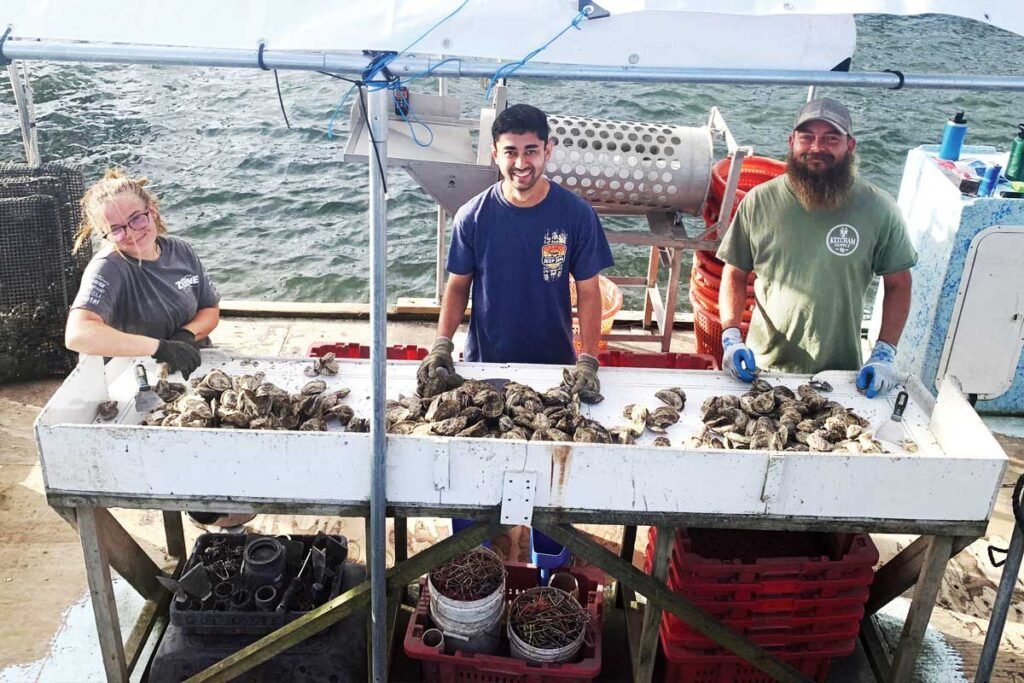
Today’s main task involves harvesting. Raising a cage and extracting a flattened bag proves to be quite physical. The cage structures are surrounded by lively marine life, including crabs, seaweed, and small fish. Smith states, “Our farm has essentially become a floating reef.”
The oysters from the bags are sorted through a rotating perforated cylinder, separating the smaller ones and directing those ripe for harvest. Some smaller oysters will be donated to Oyster River Ecology, a local restoration initiative aimed at bolstering the wild populations essential for the ecosystem’s health. Smith distinguishes between the two: “Cultivation is meant for consumption, and restoration serves the environment.”
The repetitive process of scraping and sorting provides an opportunity to delve into the personal motivations behind this endeavor. Ballard passionately states, “Raising an animal that sequesters carbon, cleanses water, and nurtures habitat has opened my eyes to the immense work that still lies ahead for maintaining our environment.”
Summarizing the experience, Smith reflects: “It’s a joy and a privilege to be involved in a business that brings this level of happiness to people. Have you ever come across a photo of someone not smiling while enjoying oysters?”
Day Two: On the Atlantic
Arriving at a dock on the Indian River Lagoon, I meet Nicolette Mariano of Treasure Coast Shellfish. As we glide over the clear waters, she shares that her passion for aquaculture began as a teenager volunteering at the Florida Oceanographic Coastal Center. A Bachelor of Science degree supports her dedication to this field. “Being out on the water early in the morning, surrounded by the sounds and scents of nature—the ospreys, dolphins, and manatees—is something I cherish,” she says.
Back at the dock, her team begins to sort through the oysters; any damaged ones are returned to the shallow waters where a variety of fish gather to feed. Mariano considers the local advantages of their farm: “The oysters create a remarkable three-dimensional habitat for juvenile organisms; our farm functions as its own little ecosystem. Additionally, we provide numerous jobs for community members of all ages.”
The Challenges
While mortality events and complex regulations present obstacles, the weather remains the gravest challenge. Hurricanes can devastate farms; Smith at Calusa recalls losing an entire year’s harvest due to Hurricane Helene. “Resilience, determination, creativity, and flexibility are crucial. We always find a way to adapt and push onward.”
Support from the Florida Shellfish Aquaculture Association is invaluable, with Executive Director Adrianne Johnson expressing their goal: “Shellfish farmers are incredibly dedicated, innovative, and hardworking individuals. We aim to elevate this exciting emerging industry in the South and invite everyone to participate. Try a southern oyster, back a local farmer, and experience the difference.”
Despite numerous hurdles, Ballard from Calusa voices a sentiment shared by many farmers: “I would not trade this job for anything.”
This article first appeared in the November/December 2025 issue of Thewindowsclubs magazine (US edition).