If you’re at all familiar with oysters, you’ll know that the northern U.S. coasts are celebrated for their exceptional shellfish. Enthusiasts rave about Beausoleils and Wellfleets from the East Coast, while others extol the virtues of Kumamotos and Hama Hamas from the West Coast.
However, when it comes to oysters from the Southeast, the response is often less than enthusiastic—people wrinkle their noses, pursing their lips and shaking their heads. Poor-quality oysters from warmer waters? Not on my plate of crushed ice. I must admit, I used to share that sentiment.
That was until I serendipitously discovered Shark Bite oysters from New Smyrna Beach, Florida, which opened my palate to an entirely new perspective. At an Oyster South symposium in St. Augustine, I encountered a dedicated group of passionate entrepreneurs determined to revive the Southern oyster’s reputation, generate local value, and improve the environment.
They kindly invited me to spend a few days at their oyster farms. Equipped with rubber boots and sunscreen, I was excited to venture into the waters of the Atlantic and Gulf.
Day One: In the Gulf
It was a stunning morning when Reed Smith from Calusa Oyster Company welcomed me to South Tampa Bay. His young associate, Reid Ballard, took us out to their lease as Smith recounted how he and his wife Maura essentially stumbled into the business of oyster farming, exclaiming, “Hey, we could do that!”
“My family enjoys seafood, so it was a logical path to take,” Smith explained as he pointed to the shimmering waters and clear skies. “And the work environment has its perks.”
Oyster farming in the Southeast often takes place in estuaries, utilizing an “off-bottom” method to allow the tides to consistently refresh the nutrient supply. Floating cages in the water hold mesh bags filled with oysters at different growth stages.
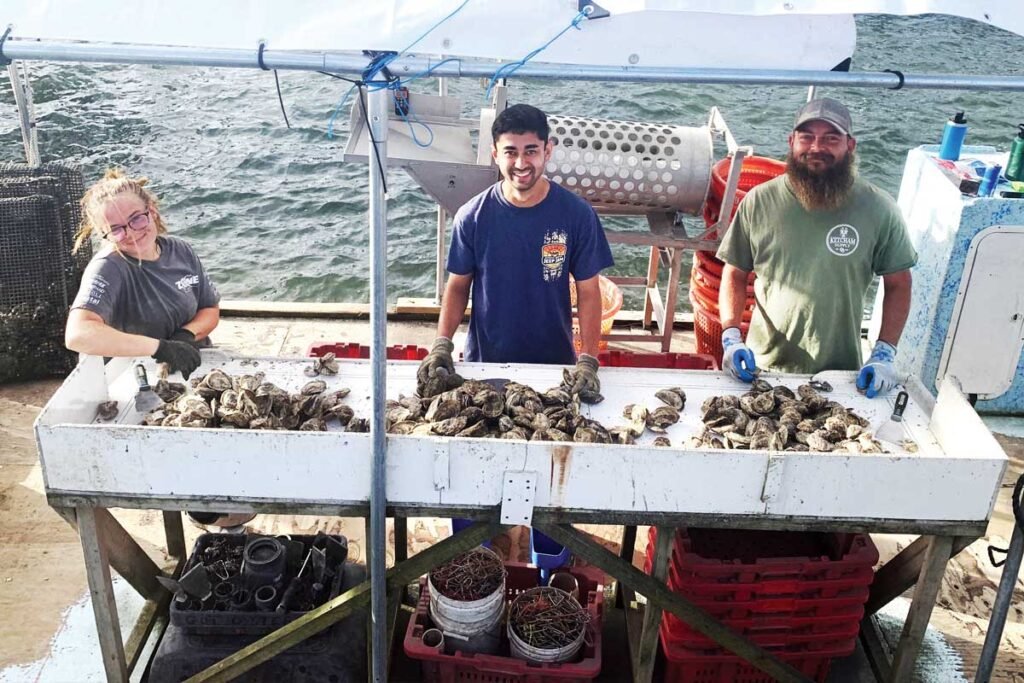
The focus today was on harvesting. Lifting a cage and extracting a flattened bag proved to be quite the workout. The cages were alive with various marine life—seaweed, crabs, and small fish surrounded us. As Smith noted, “Our farm resembles a floating reef now.”
The bags were processed through a rotary perforated cylinder, which differentiated the smaller oysters from those ready to be harvested. Some of these smaller oysters would be donated to a local restoration project, Oyster River Ecology, which is crucial for supporting wild populations that maintain the health of these waters. Smith highlighted the distinction: “cultivation is for consumption, while restoration benefits the environment.”
This somewhat laborious task provided ample opportunity for personal reflections on this rewarding lifestyle. Ballard shared his enthusiasm: “Cultivating an organism that absorbs carbon, cleans water, and fosters habitat growth has made me aware of the ongoing work needed to sustain a clean environment.”
Smith encapsulated the experience, saying: “Finding a venture that spreads joy in people’s lives is incredibly fulfilling. Have you ever seen anyone frown while enjoying oysters?”
Day Two: In the Atlantic
I next boarded a skiff with Nicolette Mariano of Treasure Coast Shellfish at the dock along the Indian River Lagoon. As we glided over the clear waters, Nicolette shared that her passion for aquaculture ignited when she volunteered at the Florida Oceanographic Coastal Center at just 14 years old. Her Bachelor of Science degree underpins her enjoyment of this profession. “I cherish the early mornings on the boat, soaking in all the sights and sounds—the ospreys, dolphins, and manatees surfacing for air,” she said.
Upon returning to the dock, her crew donned slickers and began to sort through the oysters, discarding any damaged ones into the shallow waters, where fish gathered eagerly. Mariano emphasized the positive local impact of their farm. “The oysters create an impressive vertical habitat for juvenile marine organisms; the farm serves as a miniature ecosystem on its own. We’ve generated several jobs for people in our community of all ages.”
Facing Challenges
While mortality events and regulatory complexities pose their own challenges, weather remains the most significant obstacle. Hurricanes can devastate farms; for example, Smith of Calusa lost an entire year’s yield to Hurricane Helene. “It requires grit, hard work, creativity, resilience, and adaptability. We simply find ways to push through and keep going,” he stated.
The Florida Shellfish Aquaculture Association offers community support, with Executive Director Adrianne Johnson summarizing their mission: “Shellfish farmers are some of the most diligent, resilient, and innovative individuals I know. We aim to uplift this burgeoning southern industry and encourage people to participate. Support local farmers, taste southern oysters, and savor the difference.”
Despite the various hurdles, Ballard from Calusa resonates with his peers when he declares: “I wouldn’t trade this job for anything.”
This article initially appeared in the November/December 2025 edition of The Windows Club magazine (U.S. edition).