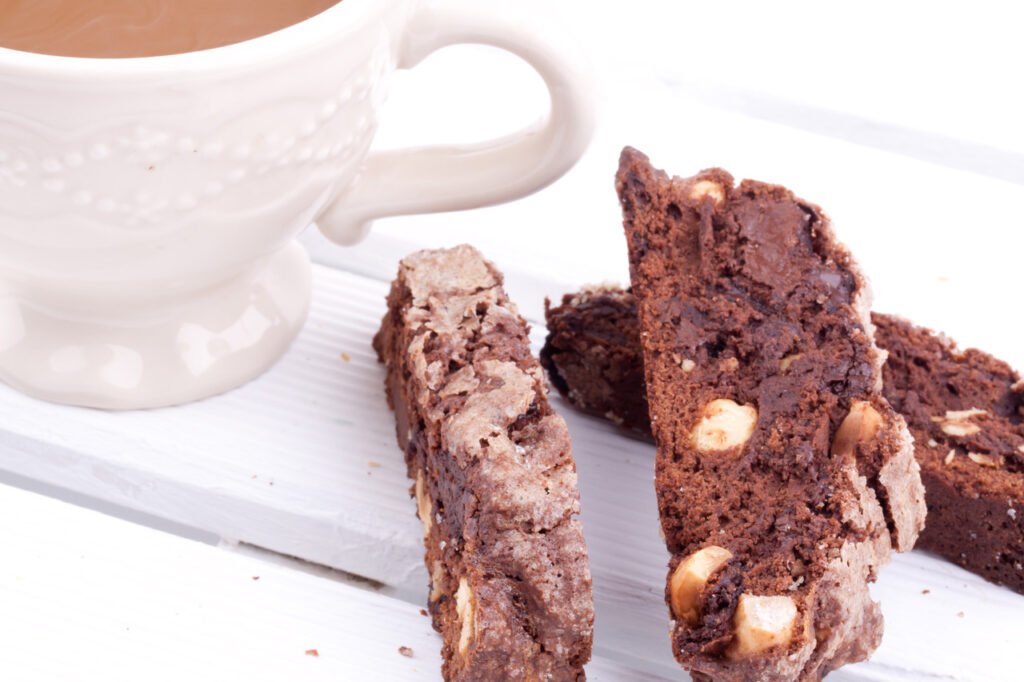
While these biscotti may not resemble the ones your Italian grandmother made, they are undeniably delicious and easy to prepare once you gather the necessary ingredients, even though the process involves several steps. They have won over many fans and might just be the most delightful cookies you ever try. You can prepare the candied zest, toasted coconut, and toasted almonds well in advance—be it days, weeks, or even months—and store them in the freezer or refrigerator.
Ingredients:
- 4 cups (18 ounces) all-purpose flour
- 1 teaspoon baking powder
- 1 teaspoon kosher salt
- ¾–1 cup Dutch-process cocoa powder
- 8 ounces unsalted butter, softened
- 1 cup light brown sugar, firmly packed
- 1 cup granulated sugar
- 4 jumbo eggs, plus the egg white from one extra egg for washing
- ¼ cup orange simple syrup plus a little for the egg wash (this syrup is a byproduct of making candied orange zest and can be stored indefinitely in the refrigerator in a Ball jar)
- 2 teaspoons pure almond extract
- 1 teaspoon pure coconut extract (omit if only synthetic options are available, as they can impart an undesirable taste)
- 1 teaspoon lemon oil
- 1 teaspoon orange oil (can be found at King Arthur Flour)
- 1 teaspoon pure orange extract
- 1 tablespoon pure vanilla extract
- 1 cup candied orange zest (not packed), finely chopped with some of its sugar (refer to recipe instructions—this zest is different from candied peel as it excludes the bitter white pith)
- 2 cups roasted and roughly chopped almonds
- 1½–2 cups sweetened shredded coconut, toasted
- 12 ounces bittersweet chocolate, chopped or in chip form
For premium chocolate options, including chips and cocoa, King Arthur Flour is an excellent online destination. Different cocoa powders come with varying fat contents, and those with a higher fat content often provide superior flavor. I prefer to order chocolate during colder months to prevent melting during shipping.
Start by whisking together the flour, baking powder, salt, and cocoa powder in a bowl.
In another bowl, cream the softened butter with both types of sugar until fluffy. Next, incorporate eggs one at a time, beating well. Afterward, mix in all the extracts, flavored oils, and orange simple syrup, scraping down the bowl’s sides to ensure thorough mixing. Gradually stir in the chopped candied orange zest and the flour blend. If the mixture appears overly sticky, add some extra flour. Finally, fold in the nuts and chocolate. The resulting dough should be stiff and slightly sticky. Cover it and let it rest in the refrigerator for at least half an hour, but up to two hours. If allowed to rest overnight, the dough will become quite firm and challenging to handle.
Preheat your oven to 350°F and line a half-sheet pan with parchment paper or a Silpat. This will make it easier to transfer the baked logs for cutting later, especially since you’ll use an egg-white glaze.
On a sugared surface (not floured), shape the chilled dough into logs approximately 1½ to 2 inches wide, 1 inch tall, and 13 to 15 inches long. Place the logs onto the prepared pan, ensuring at least 3 inches of space between them as they will expand while baking. The dough yields about 3 to 3½ logs, requiring two baking batches. Once formed, brush the tops and sides of the logs with a mixture of egg white and orange simple syrup, helping them achieve a beautiful sheen and stability for cutting after the initial bake. Consider sprinkling some additional sugar on top for an attractive finish; crystalline sugar works well for this purpose.
Bake the logs at 350°F for 35 minutes (or 45 minutes if refrigerated overnight), rotating the pan midway through the baking time. Using just one pan at a time yields the best results. Once baked, let the logs cool for 15 to 30 minutes before handling, as this cooling period helps prevent crumbling during cutting.
Carefully transfer the cooled logs to a cutting board, using a spatula for assistance. Cut them at an angle with a serrated knife into pieces that are at least ½ inch thick, allowing each piece to remain upright for the second baking. Arrange the cut cookies on the pan, standing up and slightly spaced apart. Lower the oven temperature to 275°F (250°F if using convection) and bake them again for 25 to 30 minutes. Once done, remove and let cool; the biscotti will become crisp as they cool. To extend their shelf life, store them in the freezer—if they last that long!
Preparing the Candied Orange Zest
To make the candied orange zest, zest three or more oranges (making sure to avoid the bitter white pith) with a vegetable peeler. Simmer the zest in a few cups of simple syrup (equal parts filtered water and sugar) until the syrup thickens slightly and the zest softens, which takes about 15 to 20 minutes. I find that the standard advice to blanch the zest in water, discard the liquid, and repeat, is unnecessary and wasteful. Instead, I skip this step and still achieve flavorful results. After cooking, lift the zest out with tongs and let it drip before placing it in a generous amount of dry cane sugar. Toss it until fully coated and then allow it to dry in the sugar for a few hours.
Store (1) the candied zest along with any leftover coating sugar in a Mason jar and (2) the reduced orange simple syrup in another Mason jar for flavoring purposes. This flavored syrup, when mixed in equal parts with egg white, creates an exquisite glaze. You can reuse the orange syrup for future batches of candied orange zest by adding equal parts water and sugar; the flavor intensifies with each use. Should the syrup begin to crystallize, simply heat it gently to refresh, adding water as necessary.
Editor’s Note: This recipe is courtesy of Kenneth M. Horwitz, the author of Deep Flavors: A Celebration of Recipes for Foodies in a Kosher Style. The book is available for purchase at www.deepflavorscookbook.com, or you can find it on Amazon or Kindle.